Best AI Tools to Launch Ad Campaigns End to End (2026)
Which AI tools handle each stage of an ad campaign end to end? Compare brief, creative, audience, launch, and optimization tools for Google and Meta in 2026.


On this page
In 2026, most guides about AI advertising tools list creative generators. That is useful for one stage of a campaign. A real end-to-end launch involves five distinct stages, and most teams cobble together a different tool for each one, then wonder why reporting is messy, budgets get misallocated, and creative fatigue goes undetected for weeks.
This guide covers each stage separately, names the best tool options at each, explains the gaps nobody talks about, and then explains when a single platform that spans all five stages is worth using instead of a stack.
The five stages of an end-to-end ad campaign are: brief and strategy, creative production, audience setup, campaign launch, and optimization. Most AI tools cover one or two stages. Only a small number of platforms handle all five without requiring you to sync data manually across tools. For teams running Google Search, Performance Max, or Meta campaigns, the Hellyeah platform handles all five stages with AIMA, its built-in AI engine.
What "end to end" actually means in paid advertising
A campaign does not start when you upload a creative. It starts when you answer: who is this for, what do we want them to do, and what will we say? It ends not at launch but after you have used performance data to cut what is not working and scale what is.
The five stages:
- Brief and strategy: defining the audience, the offer, the channels, and the success metrics before anything is produced
- Creative production: generating the ads themselves, including static images, video, and copy variants
- Audience and targeting setup: building the audiences, lookalikes, and exclusions in your ad platform
- Campaign launch: structuring the account, setting bids, uploading creatives, and going live
- Optimization and reporting: reading performance signals, cutting underperformers, reallocating budget, refreshing creative
The gap most teams fall into: they use an AI creative tool for stage 2, their ad platform's native tools for stages 3 and 4, and a third-party analytics tool for stage 5. The brief at stage 1 never gets documented at all. That disconnected stack means insights from stage 5 do not automatically feed back into stage 1 for the next creative cycle.
Understanding where each tool fits prevents the most common mistake: buying a creative tool and calling it an end-to-end solution.
Brief and Strategy Tools
The brief is the most underinvested stage in AI tooling because it produces no visible deliverable until the campaign launches. But a weak brief produces weak targeting, generic creative, and misaligned success metrics. Teams that skip a structured brief lose time to revisions after launch rather than before it.
| Tool | Best for | Data access | Starting cost |
|---|---|---|---|
| ChatGPT / Claude / Gemini | Initial brief drafting and copy frameworks | None; theoretical briefs only | Free to $20/mo |
| Hellyeah Managed Growth | Strategy grounded in real account history | Full account conversion history | 5% of managed spend |
ChatGPT, Claude, Gemini: General-purpose AI assistants can take a product description, a target audience, and a goal and output a structured campaign brief. They cannot read your ad account data, so the brief is theoretical rather than data-informed. Use them to draft the document; validate assumptions against your historical performance before committing media budget.
Hellyeah's Managed Growth: For teams running managed campaigns on Google Search, Performance Max, or Meta, the Hellyeah platform, powered by AIMA, starts with a strategy layer that reads your existing account signals before a brief is written. That means audience assumptions are grounded in real conversion data from your account, not general market assumptions. The AIMA engine identifies which segments have converted before, which creative formats have driven the lowest cost per acquisition, and which channels have the best efficiency ratio for your specific product.
For ecommerce and DTC brands, a brief that anchors to historical ROAS by product category will produce more efficient campaigns than one built from buyer persona templates. The difference shows up within the first two weeks of the campaign. Teams that want this layer without building an in-house analyst function can run it through the Hellyeah platform's Managed Growth feature.
Creative Production Tools
Most AI advertising guides start and stop here. The options here have changed what is possible for lean teams, but the variation between tools is significant and most comparisons underweight it.
| Tool | Creative format | Starting price | Best for |
|---|---|---|---|
| AdCreative.ai | Static images + copy variants | Under $30/mo | Ecommerce banner volume |
| Pencil | Predictive video ads | Low hundreds/mo | DTC video production |
| Creatopy | Multi-format resize and adapt | Varies | High-volume format scaling |
| Predis.ai | Social ad generation | Varies | High-cadence social campaigns |
| Runway | Custom AI video | Varies | Distinctive brand video |
| Creatify | Short-form video | Varies | TikTok and Reels formats |
AdCreative.ai: Generates static ad images and copy variants at scale. Plans start under $30 a month for limited credits, with higher tiers for volume production. Strong for ecommerce brands that need many banner formats quickly. Its performance scoring predicts which creatives will convert before launch, though the scoring model is vendor-reported rather than independently verified. Read our full AdCreative.ai review including current plan costs and credit limits.
Pencil: Generates video ads from product assets and predicts performance scores before you spend media budget. Plans start in the low hundreds per month. The score model is trained on over $1 billion in historical ad spend, which they cite publicly as the basis for their prediction accuracy. Best for DTC brands where video outperforms static but production costs have been a barrier. Pencil narrows the gap between a full video production team and no video capability at all.
Creatopy: Design automation for teams producing ads across many formats and sizes. Strong at the resize-and-adapt step when you need the same concept in 15 different dimensions for display, social, and search. Not a video tool. Works well alongside a video generation platform rather than as a replacement for one.
Predis.ai: Social ad generation with built-in publishing and scheduling. Useful for teams running high-frequency social campaigns where content cadence matters as much as individual ad quality.
Runway: AI video generation for teams that need distinctive, non-template video creative. Higher creative ceiling than Pencil but less automated: you are directing scenes rather than inputting a product URL and receiving a finished ad.
Creatify: Generates short-form video ads for social platforms, optimized for TikTok and Instagram Reels formats. Good entry point for brands testing video creative without a production budget.
The concept underlying all of these tools is AI creative optimization: using machine learning to produce and test multiple creative variants faster than a human production cycle allows. In 2026, the gap between a team using these tools and one relying entirely on manual production cycles has grown large enough to affect campaign outcomes materially. The difference between a team running three creative variants per week and one running thirty is not talent or budget. It is the feedback cycle.
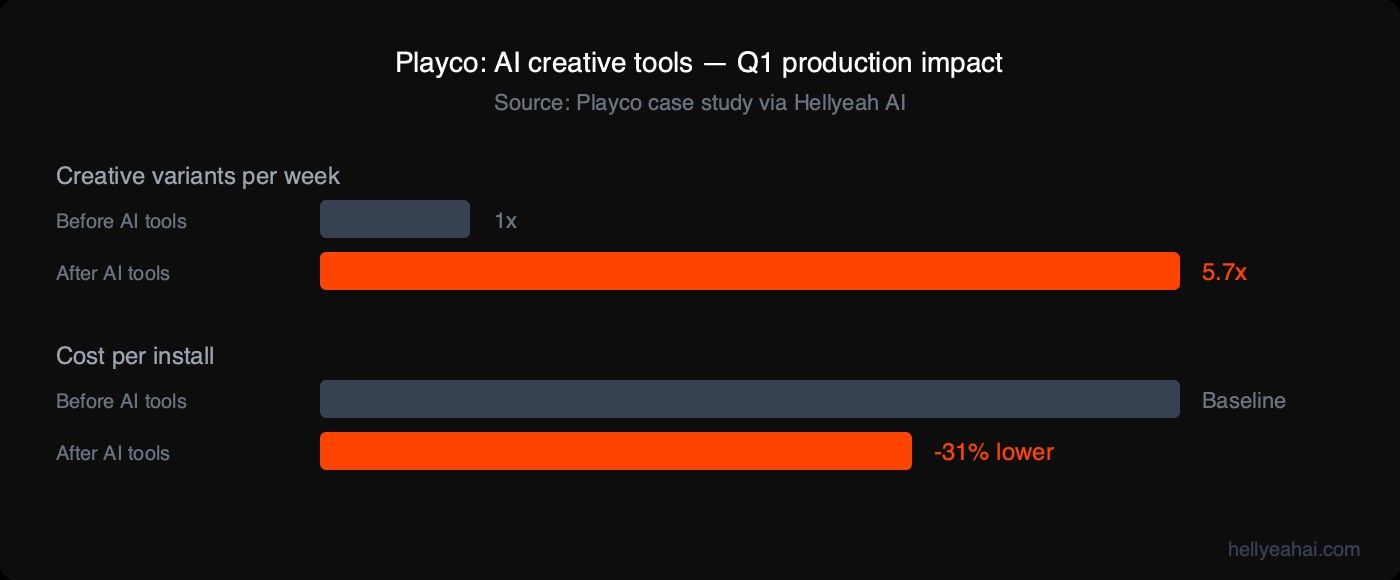
Playco, the mobile gaming company, ran 5.7 times more creative variants per week after introducing AI creative tools. Cost per install dropped 31% in the first quarter. That improvement came from iteration speed, not from a single winning creative discovered on the first try.
Whether static or video ads convert better for your product type depends on your funnel stage and audience intent: creative format should follow the data, not the trend.
Stage 2 is where most teams invest and most guides stop. The real leverage is closing the loop: signals from Stage 5 optimization should reshape what you brief in Stage 1. Tools that cannot do that automatically require an analyst to do it manually (usually two to three days per week for a lean team). Jaya Muvania, Hellyeah SEO lead
Audience and Targeting Tools
Getting the creative right is half the equation. Showing it to the wrong audience erases the advantage. This stage is where many teams spend the least time and where AI tooling has made the biggest accuracy improvements.
| Tool | Platform | Conversion data needed | Best for |
|---|---|---|---|
| Meta Advantage+ | Meta | 50+ events/month to optimize | Scaled Meta campaigns with existing data |
| Google Performance Max | 50+ events/week to exit learning | Multi-channel Google inventory | |
| Hellyeah X-Ray | Google + Meta | None required | Cross-channel audience gap analysis |
Meta Advantage+: Meta's native AI targeting system removes the need to build custom audience sets manually. It works best once a campaign has accumulated enough conversion data for the model to optimize against. New accounts with fewer than 50 conversions per month see less benefit and may need to start with interest-based or manual audience sets to build the data foundation.
Google Performance Max: PMax surfaces ads across Google's entire inventory using asset groups rather than traditional keyword targeting. The system needs 50 conversions per week across a campaign to leave the learning phase. Lower-volume accounts should start with manual search campaigns before testing PMax, because the system can distribute spend unpredictably during the learning phase on sparse conversion data.
Hellyeah's X-Ray: For accounts already running on Google or Meta, Hellyeah's X-Ray provides cross-channel audience analysis that identifies segments converting but underserved by current targeting. It reads first-party data signals to surface where budget is leaking to audiences that never convert and where spend is being withheld from high-intent segments. See how lookalike audiences work on Meta and Google for the underlying mechanics of what the models are doing.
For teams evaluating how to build audiences from first-party data, the underlying methodology behind Meta Advantage+ and Hellyeah's X-Ray uses predictive segment models that identify high-intent patterns from historical conversion events: not keyword signals.
Campaign Launch Tools
Purpose-built AI tooling has underserved this stage more than any other. Creating a strong creative and knowing your audience does not automatically produce a well-structured campaign. Account structure, bid strategy, and campaign settings require deliberate decisions that compound in their effect on performance over time.
| Tool | Platform focus | Pricing | Best for |
|---|---|---|---|
| Madgicx | Meta (FB/IG) | Varies | Automated Facebook campaign management |
| Smartly.io | Multi-channel | Quote-based | Enterprise multi-market execution |
| AdStellar AI | Meta | Varies | Hands-off Meta campaign setup |
| Hellyeah AIMA | Google + Meta | 5% of spend | Cross-platform launch with pre-integrated signals |
Madgicx: Manages Meta ad campaigns with AI-powered automation for audience, budget, and creative testing. Strong for Facebook and Instagram focused campaigns. See the Madgicx review for paid media teams for current pricing, plan limits, and where the tool requires manual override.
Smartly.io: Enterprise creative automation and campaign management built for high-volume, multi-market teams. Pricing is quote-based. Best suited for brands running complex creative testing across multiple markets simultaneously, where the administrative overhead of manual campaign management becomes a bottleneck.
AdStellar AI: Generates creatives and launches them to Meta with automated testing built into the launch sequence. More opinionated about account structure than Madgicx, which is a benefit for teams that want to hand off Meta execution almost entirely rather than retain control over campaign architecture.
Hellyeah's AIMA engine: The AIMA engine inside the Hellyeah platform handles campaign structuring, bid management, and launch across both Google and Meta within a single interface. Unlike point-solution tools, it reads creative performance signals from stage 2 and audience signals from stage 3 before structuring the account. That pre-launch data integration eliminates the "launch and see" guesswork that drives the first two weeks of wasted spend on most new campaigns.
The key decision at launch is how to allocate budget between Google and Meta. The answer varies by funnel stage, audience intent, and product type. A campaign that spends equally across both channels without understanding where each converts is leaving efficiency on the table from day one.
Optimization and Reporting Tools
Most of the value from AI advertising tools comes at this stage, and it is also where the data fragmentation problem is most visible. If your creative tool does not know your conversion rate by audience segment, it cannot suggest which creative directions to pursue next. If your reporting tool does not know which creative is running, it cannot attribute performance accurately.
| Tool | Attribution approach | Monthly spend sweet spot | Best for |
|---|---|---|---|
| Triple Whale | First-party + platform data | Any DTC spend level | Post-iOS attribution for ecommerce |
| Northbeam | Media mix modeling | $200K+ | Incrementality measurement at scale |
| GA4 + native reporting | UTM-based | Any | Free baseline with consistent UTM discipline |
| Hellyeah X-Ray | Real-time AIMA feedback loop | Any | Active optimization without manual review |
Triple Whale: Cross-channel attribution for DTC ecommerce brands. Combines ad platform data, Shopify revenue, and first-party signals into a single dashboard. Strong for post-iOS attribution challenges where platform-reported metrics have diverged from actual business outcomes.
Northbeam: Media mix modeling designed for DTC and growth-stage brands. More accurate on incrementality than last-click models, longer to onboard. Best for brands spending above $200K per month where measurement precision justifies the setup investment.
Google Analytics 4 plus native platform reporting: The free option. Still sufficient for most campaigns if you build consistent UTM discipline. The weakness is cross-channel comparison: Meta's attribution window and Google's do not align by default, so blended ROAS calculations require manual adjustment to be meaningful.
Hellyeah's X-Ray: Beyond audience analysis at stage 3, Hellyeah's X-Ray monitors live campaign performance and flags budget waste in real time. It is not a standalone reporting dashboard. It feeds signals back into AIMA so optimization happens automatically rather than through manual analyst review. The practical impact: budget reallocation that would take an analyst two hours to identify and implement happens within one optimization cycle, typically within 24 hours of performance data appearing.
Ad creative fatigue is one of the most common causes of campaign underperformance and one of the least-monitored signals. Most teams identify fatigue by looking at frequency capping data after performance has already dropped. AIMA tracks creative performance trends continuously and surfaces fatigue signals before they produce visible ROAS decline.
One Platform Versus a Tool Stack
The case for building a stack: you can use best-in-class tools at each stage and keep costs modular. If one tool underperforms, you swap it out without rebuilding everything.
The case for one platform: every stage produces data that should feed into every other stage. A creative tool that does not know your conversion rate by audience segment is optimizing in the dark. A bidding tool that does not know which creative variants are fatiguing is allocating budget to dead assets.
| Factor | Tool stack | Single platform (Hellyeah) |
|---|---|---|
| Data handoffs between stages | Manual; analyst required | Automatic |
| Cost structure | Per-tool pricing, accumulates | One fee: 5% of managed spend |
| Time from signal to action | 2-3 days (manual reconciliation) | Within one optimization cycle (~24h) |
| Customization | Best-in-class per stage | Platform-defined workflow |
| Team overhead | Increases with each tool added | Consistent regardless of scale |
The disconnected stack also creates a team coordination problem. Someone has to pull reports from the creative tool, compare them against audience performance data from stage 3, reconcile that with conversion attribution from stage 5, write a new brief for stage 1, and brief the creative team at stage 2 again. For a team of one or two people managing multiple channels, that loop takes two to three days per week. For a larger team, it creates handoff failures where insights get lost between departments.
The Hellyeah platform handles all five stages within AIMA. Strategy input from stage 1 shapes creative parameters at stage 2. Audience signals from stage 3 inform bid strategy at stage 4. Optimization signals from stage 5 automatically refresh creative briefs without requiring an analyst to pull reports and write a new brief manually.
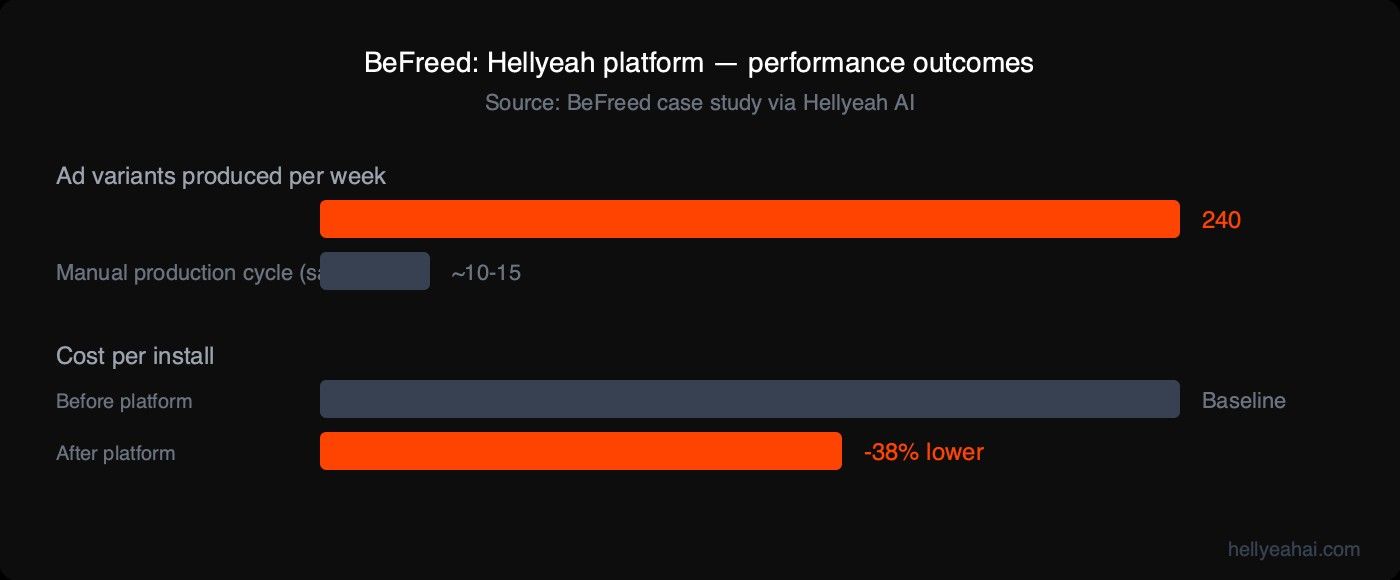
BeFreed produced 240 ad variants per week using the Hellyeah platform. Cost per install fell 38% in the same period. The improvement came from AIMA reading stage 5 optimization signals and automatically feeding them back into stage 2 creative direction, a loop that requires either dedicated analyst time or a platform designed to close it without manual intervention.
For teams that prefer a hybrid approach: use specialized creative tools at stage 2 and connect them to an end-to-end platform for stages 3 through 5. The key is eliminating manual data hand-offs between stages, which is where performance insights get lost.
If you want to see what AIMA would do differently with your current campaigns, get started with Hellyeah's Managed Growth.
Related Guides
Frequently asked questions
What does "end to end" mean for AI ad campaign tools?
End to end means the tool handles every stage from strategic brief through creative production, audience setup, campaign launch, and ongoing optimization. Most tools cover one or two stages. True end-to-end platforms eliminate the manual data transfer between stages where performance insights typically get lost.
Which AI tools work for both Google and Meta campaigns?
Most AI creative tools export to both platforms. For campaign management, Hellyeah's AIMA engine handles Google Search, Performance Max, and Meta Awareness and Lead Gen campaigns natively. Smartly.io also covers both channels at enterprise scale.
Do I need all five stage tools, or can I start with just creative AI?
Starting with creative AI at stage 2 is sensible if your main bottleneck is ad production speed. Most teams see diminishing returns from creative volume once they hit 10 to 20 variants per campaign; at that point, the constraint usually shifts to audience targeting or optimization rather than production volume.
How much do AI ad campaign tools cost?
Entry-level creative tools typically start below $50 a month. Professional-grade campaign management tools vary widely by feature set and usage tier. End-to-end platforms typically charge a percentage of managed ad spend. Hellyeah charges 5% of media spend managed through the platform with no hidden media markup.
Can AI tools replace a paid media specialist?
AI platforms handle execution-layer tasks that paid media specialists traditionally do: campaign structuring, bid management, creative testing, and reporting. They cannot replace strategic decisions about positioning, audience development, or brand voice. The strongest setup for most growth-stage teams is an AI platform for execution and a retained strategist, either in-house or fractional, for direction.
What is the biggest mistake teams make when building an AI ad stack?
Buying tools at stage 2 (creative generation) while leaving stage 1 (brief) unstructured and stage 5 (optimization) manual. Creative volume without a feedback loop produces more creative waste, not better creative performance. The brief tells the tools what to optimize toward; the optimization loop tells the brief what is actually working.

SEO and growth
SEO and growth at Hellyeah. Writes about how AI changes the way people find and evaluate products.


