

On this page
Facebook ads for photographers produce measurable session inquiries when the campaign objective is Lead Ads, not Awareness. Most photographers running a $300 monthly budget on Lead Ads with Instant Forms generate 8 to 20 local inquiries in their first month; Awareness campaigns at the same spend generate impressions with no direct booking signal. This guide covers objective selection, targeting, creative, budget math, and how to run the whole system without an agency.
Quick Answer
- Lead Ads with Instant Forms outperform Awareness campaigns for photographers because leads are collected inside Facebook with no website required, and the algorithm optimizes for inquiries rather than impressions.
- Target by location first (25 to 50 mile radius), then layer life-event signals like recently engaged or new parents, and run a warm retargeting audience alongside cold traffic from day one.
- Budget $300 to $500 monthly to give the algorithm enough data to exit the learning phase; splitting less than $300 monthly across multiple ad sets keeps every campaign stuck in learning indefinitely.
Lead Ads With Instant Forms Fill More Photography Calendars Than Awareness Campaigns
The default advice for photographers new to Facebook ads is to run an Awareness campaign. The logic sounds right: show your work to as many people as possible, build recognition, wait for bookings. In practice, it burns through budget without producing inquiries you can act on.
Why awareness ads are expensive and imprecise for solo photographers
Awareness campaigns optimize for reach and impressions. Facebook charges you per thousand people who see your ad, and the algorithm gets better at finding people who will look at it, not people who will book a session. For a photographer spending $300 to $500 a month, reach with no conversion signal produces no feedback loop. You learn which image got more views; you don't learn which image generated inquiries.
A benchmark from ACT Global Marketing puts the cost per lead for photographers at $8 to $28 using Lead Ads, compared to no measurable CPL for Awareness campaigns that don't include a form. With a session booking worth $300 to $3,000 to a photographer, even a $40 cost per lead is a strong return. Awareness campaigns never surface that number at all.
As of 2026, Meta's Lead Ads are the default recommendation for service-based businesses collecting local inquiries, and Instant Forms are the format photographers in particular benefit from most.
How Instant Forms capture bookings without a website
Lead Ads work differently. When someone taps your ad, an Instant Form opens inside Facebook or Instagram, pre-filled with the user's contact information from their profile. They submit their name, email, and phone number without leaving the app. No website required, no landing page to build, no redirect that loses 40 to 60% of mobile users mid-funnel.
Instant Forms are the highest-converting Meta ad format for service-based bookings like photography. Because the form opens natively inside Facebook and Instagram, users don't experience a page load, a layout shift, or a moment of friction where they abandon. For a photographer running a $300 monthly ad budget, Lead Ads with Instant Forms typically produce 8 to 20 qualified inquiries monthly in a local market, at a cost per lead of $15 to $40 depending on niche and targeting precision. That's a direct booking pipeline from a platform most potential clients check multiple times per day.
How to Reach Photography Clients Without Burning Budget on the Wrong Audience
Targeting is where most photography ad budgets fail silently. Broad interest audiences like "photography" or "portrait photography" target people who like photography as a hobby, not people who want to hire a photographer. The Facebook audience targeting strategy that works for photographers is built around intent signals: location, life stage, and behavior rather than general interests.
Cold audiences by location and life event
Start with location. Set a 25 to 50 mile radius around your service area, then narrow by life-event signals that correlate with photography purchases. Facebook's targeting options include recently engaged (for wedding and engagement photographers), parents of newborns (for newborn and family photography), and anniversary milestones.
In practice, a cold audience for a wedding photographer in a mid-size city might be: ages 22 to 40, 35-mile radius, relationship status recently changed to engaged, interests include wedding planning or bridal. Keep the audience size between 50,000 and 500,000 for a local market. Small enough to be specific, large enough to give the algorithm room to find the right people.
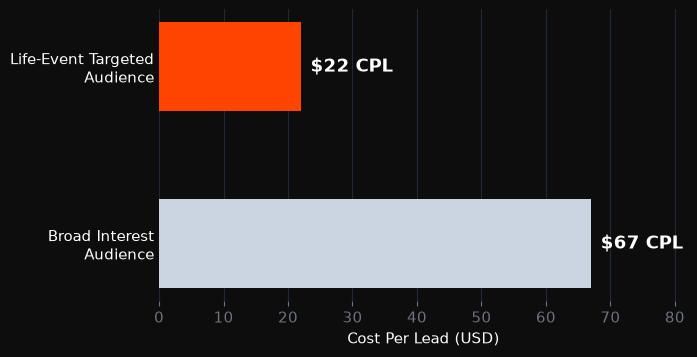
A portrait photographer in Phoenix targeting new parents within 30 miles set her Lead Ads budget at $15 daily. Her CPL ran $67 in week one with a broad interest audience. She switched to the new parents life-event filter and cut the radius to 25 miles. CPL dropped to $22 in week two, and she booked 8 sessions from 17 leads in the first month.
Retargeting warm audiences
Cold audiences get you in front of people who have never heard of you. Warm retargeting audiences get you in front of people who have. Build a retargeting audience from anyone who visited your Facebook Page in the last 30 days, watched 50% or more of any video you have run, or engaged with any of your posts. These people already know your work. A direct offer, such as "Book your fall mini session before Saturday dates are gone," converts warm traffic at 2 to 4x the rate of cold audiences running the same creative.
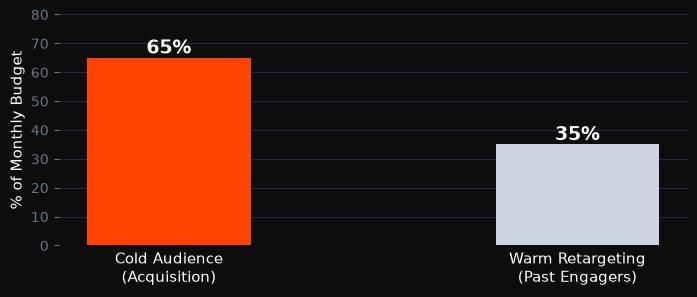
Run warm and cold audiences in separate ad sets so the algorithm can allocate budget to each independently. If your budget is $300 to $500 monthly, put 60 to 70% toward cold audience acquisition and 30 to 40% toward warm retargeting.
Lookalike audiences from past clients
Once you have 100 or more past client contacts, upload that list to Meta and create a 1 to 2% lookalike audience. Facebook finds people in your local market who look like your existing clients based on demographics, behavior, and interests. Lookalike audiences typically outperform broad interest targeting after the first few months, once the source audience is large enough to be statistically meaningful.
What Ad Creative Books Photography Sessions on Facebook
The most common creative mistake photographers make is designing ads the way they compose photographs: centered subject, balanced frame, careful lighting. Mobile feed ads don't work that way. The scroll happens fast, and creative that blends into the feed doesn't stop anyone.
Static vs. video ad testing data shows that single-image ads outperform video in cold audience acquisition for most service categories. For warm retargeting audiences, video and carousels typically perform better. That distinction changes how a photographer should allocate creative production time.
Vertical single images outperform square format in the mobile feed
Meta's feed prioritizes vertical formats. A 4:5 image is taller than a 1:1 square at the same width, which means it occupies more of the scroll before the user moves on. On mobile, more screen space equals longer dwell time, which equals better engagement signals sent back to the algorithm.
For photographers, a single strong image in 4:5 (one emotional moment, one face, a scene that communicates your niche instantly) outperforms polished carousels in cold traffic testing more often than not. The goal in the first frame is a scroll-stop, not a portfolio showcase. That comes later. Stories and Reels use the 9:16 vertical ratio; a 4:5 image placed in a Story gets pillarboxed and looks unintentional.
Carousels for photographers who want to show range
Carousels make sense when the reader is already warm: they have engaged with your Page, visited your site, or watched a video. For cold audiences, a carousel requires the user to swipe, which is an action most cold traffic won't take. For retargeting audiences, a four to six image carousel showing different session types, moments, or styles can increase inquiry intent by giving the reader enough context to self-select your niche as the right fit.
Don't carousel your full portfolio. Pick four to six images that represent your highest-value session types and sequence them as a narrative. A carousel that tells a story performs better than one that samples your range.
Copy hooks that turn scrollers into inquiries
Photography ad copy works when it leads with the client's situation, not the photographer's credentials. "Only 3 Saturday dates left for October" works because it creates real scarcity and urgency. "Award-winning photographer serving the Bay Area" does not. It's about the photographer, not the client.
In the primary text: two or three sentences maximum for cold audiences. One strong sentence for warm retargeting. The CTA button should match commitment level. Use Learn More for cold audiences, and Request Information or Book Now for warm.
An Instant Form paired with copy that names a specific offer, such as "Check availability for your November session," pre-qualifies leads before they submit. Anyone who fills out a form knowing it's about a specific session type is a more qualified inquiry than someone responding to a generic "Contact us."
Photography Facebook Ad Budget Math That Exits the Learning Phase
Facebook's algorithm enters a learning phase when an ad set is new or significantly edited. During learning, the algorithm tests delivery to find the right people at the right times. Budget choices during this phase determine whether a campaign ever graduates to stable, efficient delivery. The full Facebook ad budget breakdown has the numbers by spend level, but here is the version that applies specifically to photographer budgets.
What the learning phase means at $300 to $500 monthly
Meta's 2026 standard guidance is 50 conversion events in 7 days to exit the learning phase. For a photographer running Lead Ads at a $15 to $30 cost per lead, that means $750 to $1,500 in spend per ad set each week, which is a budget only high-volume studios or commercial photography firms can sustain.
For photographers spending $300 to $500 monthly, the math changes. At $15 daily (roughly $450 monthly), reaching 50 leads in 7 days is not realistic. What works instead is consolidating into one or two ad sets, letting the learning phase run 3 to 4 weeks, and using engagement signals (form starts, link clicks, video views) to guide initial creative decisions before cost-per-lead data matures. The mistake is splitting a $15 daily budget across 5 ad sets. Each gets $3 daily, which produces no signal at all.
Starting budget by photography niche
These are working estimates based on typical local market performance. CPL varies by market, season, and creative quality.
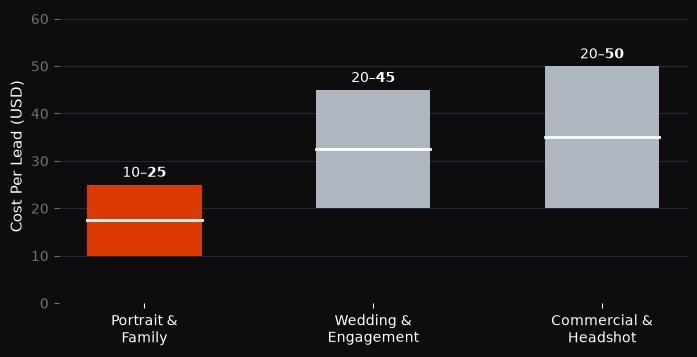
Portrait and family: $200 to $400 monthly; expected CPL $10 to $25; realistic inquiries monthly 8 to 20. Wedding and engagement: $400 to $700 monthly; expected CPL $20 to $45; realistic inquiries monthly 8 to 20. Commercial and headshot: $400 to $600 monthly; expected CPL $20 to $50; realistic inquiries monthly 6 to 15.
For any niche, the minimum useful budget is $300 monthly concentrated in a single ad set. Below that, the algorithm doesn't have enough spend to find the signal.
How Hellyeah Runs Facebook Lead Ads for Photographers
Hellyeah is an AI-first growth platform that runs and improves paid ads across Google and Meta. For photographers, the platform handles the full Meta Lead Ads workflow: AIMA, the AI engine inside Hellyeah, builds the ad copy, selects and formats images in 4:5 and 1:1 ratios, creates the Instant Form, sets targeting, and manages budget from a prepaid wallet. Leads collected through Instant Forms flow directly into the Hellyeah Leads inbox, where the photographer can assign them to a team member, add notes, and qualify them without switching tools. The entire system runs on a flat 5% management fee with no long-term contracts.
AIMA builds your creative and form
Before launching ads through Hellyeah's platform, connect your Facebook Page. Hellyeah's AIMA engine then takes the brief (your session type, location, target client, and offer) and builds the ad copy, images in the right format ratios, and the Instant Form. You review and approve before anything goes live. A person approves every launch and every significant optimization change; Hellyeah is not a fully automated system. AIMA handles execution while you retain approval authority over what goes out.
For photographers who have spent hours in Meta Ads Manager learning objectives, placement breakdowns, and bid strategies, the contrast is real. The creative production loop (brief to copy to image to form) typically closes in less than a day rather than a week of back-and-forth with a creative vendor. Campaigns are funded from a prepaid wallet. Unspent budget is refunded.
The Leads inbox and what happens after someone submits
When a prospective client submits the Instant Form, the lead appears in the Hellyeah Leads inbox with their name, email, phone number, and the date they submitted. You can assign the lead to yourself, add a status (contacted, booked, lost), and track follow-up. For photographers who previously exported leads from Meta in CSV format every few days and managed follow-up manually, having leads routed directly into a structured inbox with assignable status fields removes a step that costs bookings.
The follow-up speed matters. Harvard Business Review research shows that leads contacted within an hour convert at 7x the rate of leads contacted the following day. The Hellyeah Leads inbox keeps every submission visible and actionable in real time rather than buried in a spreadsheet.
If you want to see how Hellyeah's platform handles your Facebook ads, start at hellyeahai.com.
What to Measure in Your First 30 Days of Photography Facebook Ads
Tracking early campaign data correctly prevents the most expensive mistake in photography ads: pausing good campaigns too early because the wrong metric looks bad. If your Facebook ads are not delivering, the problem is almost always one of four things: audience too narrow, creative too similar to the feed background, budget too low to exit learning, or objective mismatched to the goal.
Cost per lead is the primary metric for Lead Ads. Track it at the ad set level, not the campaign level, so you can see which audience is producing cheaper inquiries. If CPL is above $50 in week one, don't pause. The algorithm is still learning. If CPL is above $50 in week three, look at creative first, then audience.
Secondary metrics to watch: form open rate (how many people who saw the ad tapped to open the form), form submission rate (how many who opened the form actually submitted), and lead-to-inquiry rate (how many submitted leads responded when you followed up). A low form submission rate suggests the form is asking for too much or has an awkward question sequence. A low lead-to-inquiry rate suggests the audience is curious rather than intent-driven; tighten the targeting.
Give every new ad set at least $100 in spend and 7 to 10 days before making changes. Single data points at low spend are noise. Decisions made on $40 of ad spend are almost always wrong.
Author's Comment
"The failure mode I see most often with photographer clients on Meta is treating creative as the bottleneck when the brief is actually the problem. When AIMA generates images and copy for a photographer's campaign, the quality lives or dies in how well the brief describes the session type, the client moment, and the emotional outcome. A brief that says 'wedding photographer, Portland' produces generic assets. A brief that says 'golden-hour first look, outdoor ceremony, intimate and unposed style, couple in their late 20s' produces something the algorithm can actually use."
Diane, AI Creative Lead, Hellyeah AI
Three Mistakes That Drain Photography Ad Budgets
Running too many ad sets on too little budget is the most common. Every ad set needs enough budget to exit the learning phase. If you're spending $300 monthly and running 5 ad sets, each gets $60, which is noise. Consolidate to one or two ad sets, let them run long enough to produce real data, then test variations.
Changing the campaign before data matures is the second mistake. Editing a live ad set resets the learning phase. Photographers who check their campaigns daily and adjust targeting, creative, or budget in response to early data restart learning every time they touch the campaign. Set a review cadence of once per week. Make changes in a batch rather than reactively.
Using the wrong ad format for the funnel stage is the third. A portfolio carousel requires the user to actively swipe. A single strong image creates passive engagement and is more appropriate for cold traffic. Use the format that matches what you're asking the audience to do based on where they are in their awareness of your work, not based on which format looks most impressive.
FAQ About Facebook Ads for Photographers
Do Facebook ads work for photographers? Yes, particularly Lead Ads with Instant Forms. The Lead objective tells the algorithm to optimize for people who will complete an inquiry form, and Instant Forms open inside Facebook and Instagram, removing the friction of a website redirect. Wedding photographers, portrait photographers, and commercial photographers report CPLs of $10 to $50 in local markets, against bookings worth $300 to $3,000 or more.
How much should photographers spend on Facebook ads per month? The minimum useful budget is $300 monthly concentrated in one ad set. Below that, the algorithm doesn't have enough data to optimize effectively. Most photographers see stable lead costs after 30 to 45 days of consistent spend. Wedding photographers in competitive markets often need $500 to $700 monthly to generate enough inquiries to fill a booking calendar.
What ad format gets the most photography bookings? Lead Ads with Instant Forms produce the most measurable bookings for photographers with limited budgets. The form captures the inquiry inside Facebook, which eliminates a redirect step and increases submission rates. Single-image ads in 4:5 or 1:1 format paired with Instant Forms outperform carousels and video for cold audience acquisition in most testing. Video and carousels work well for retargeting audiences who already know your work.
Is Facebook or Instagram better for photographers? You don't have to choose. Meta runs placements automatically across Facebook, Instagram, Messenger, and Audience Network unless you manually restrict placement. Automatic placements give the algorithm more inventory to find the right audience at the right time. Instagram tends to outperform for visual-heavy niches like wedding and lifestyle photography. Facebook often performs better for family and commercial photography. Let the algorithm test both and check your placement breakdown after 14 days of spend.
Can photographers run Facebook ads without a website? Yes. Lead Ads with Instant Forms collect contact information inside Facebook without requiring a website or landing page. The lead submits name, email, and phone number, all pre-filled from their Facebook profile, without leaving the app. This is the primary reason the Lead objective is recommended for photographers who haven't built a dedicated booking site yet.
Related blog posts

AI creative lead
AI creative lead at Hellyeah, focused on creative direction: how the work gets generated, critiqued, and shipped.


