

On this page
Facebook ads work for restaurants because the product is visual, the audience is local, and the purchase decision is driven by hunger and proximity. A well-run campaign puts your restaurant in front of people within five miles of your door at the exact moment they are deciding where to eat. This guide walks you through how to do that without a website, a pixel, or a marketing team.
Quick Answer
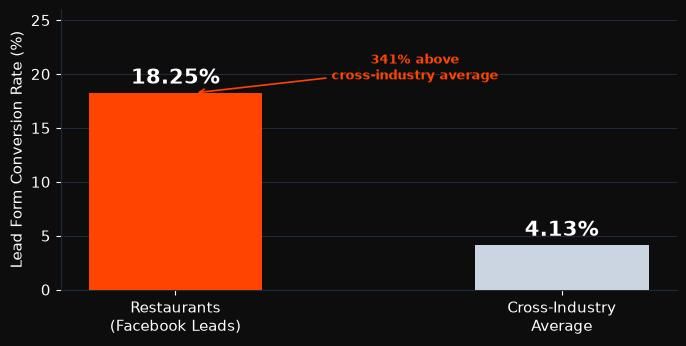
- Restaurant lead generation campaigns on Facebook convert at 18.25%, which is 341% above the cross-industry average, with a cost per lead as low as $3.16
- The most effective setup for independent restaurants uses Meta Awareness campaigns for reach and Instant Form campaigns for direct lead capture, no website required
- A starting campaign targeting a 5-mile radius can run consistently on a small daily budget and generate meaningful lead data within two weeks, with cost per lead as low as $3.16
Why Facebook Ads Work for Independent Restaurants
Most marketing channels require restaurants to wait. SEO takes months. Word-of-mouth is unpredictable. Flyers go in the recycling bin. Facebook Ads are different because they put a specific offer in front of a specific person in a specific location the same day you launch.
The numbers back this up. According to 2025 Meta advertising benchmarks, food and restaurant ads on Facebook achieve a click-through rate of 1.67% and a cost per click of just $0.72. Lead generation campaigns for restaurants hit a conversion rate of 18.25%, which is 341.52% higher than the cross-industry average. The cost per lead can drop as low as $3.16.
Three structural factors make restaurants especially strong on Facebook. First, the product is visual. A plate of pasta or a smoked brisket sandwich does not need a headline to create desire. Second, the audience is local. You are not competing against every restaurant in the country, only the ones within five miles. Third, purchase decisions happen fast. Someone sees your food at 6:30 PM, they are at your door by 7:15 PM. No nurture sequence required.
Boosting a post is not the same as running a real campaign. When you boost, Facebook optimizes for likes and comments. When you run an Awareness or Leads campaign through Meta Ads Manager, the platform optimizes for reach among people likely to visit or for actual contact information from people interested in your offer. The objective changes what the algorithm does with every dollar you spend.
Boosted Posts vs Meta Ads Manager Campaigns
Wasted spend on Facebook is most often traced to a single root cause: boosting posts instead of running campaigns.
When you tap "Boost Post" on a Facebook post, you are paying to show that post to more people. Facebook decides who sees it based on basic interest signals. As SWIPEBY's practical guide to restaurant Facebook ads explains, boosted posts do not support conversion objectives, custom audience retargeting, or lead capture. They are reach products only. You are essentially paying for visibility with no clear commercial outcome attached.
A proper campaign in Meta Ads Manager gives you three things Boost cannot. First, you choose a campaign objective that tells Facebook what result you want: Awareness (reach the most local people), Traffic (send people to a reservation page), or Leads (collect name, email, and phone via an Instant Form). Second, you control audience targeting precisely, including a geographic radius, age range, household income, and custom audiences built from your existing customer list. Third, you can split-test creative, monitor cost per result, and scale what works.
For most independent restaurants starting out, two campaign types cover 90% of what you need: an Awareness campaign to build local recognition and a Leads campaign to collect contact data for promotions and reservations directly inside Facebook, no website required.
Choosing Your Campaign Objective
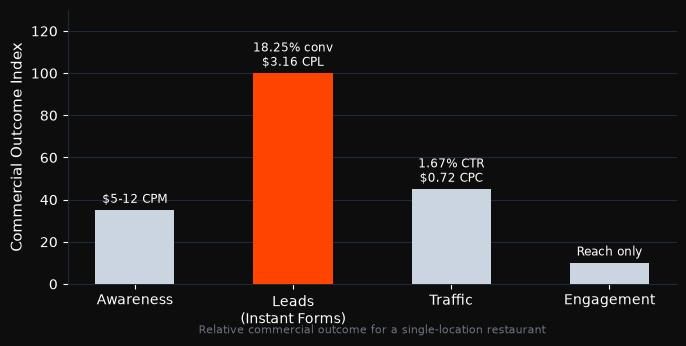
The objective you select determines everything about how your budget is spent. Here is how each one applies to a restaurant context.
Awareness: Facebook shows your ad to as many people as possible within your defined location. This is the right objective when you are new, launching a new location, or promoting a seasonal menu. The metric to watch is Cost Per 1,000 Impressions (CPM). A well-targeted local Awareness campaign typically runs $5 to $12 CPM.
Leads (Instant Forms): Facebook shows your ad to people likely to submit a form. When they click, a pre-filled Meta form opens inside the app, collecting name, email, and phone number. No website or landing page needed. This is especially powerful for reservation captures, event signups (private dining, holiday bookings), and loyalty program enrollment. This is where restaurant campaigns outperform most industries, at that 18.25% conversion rate.
Traffic: Facebook sends people to an external URL, such as your online ordering page, OpenTable profile, or website. This requires a destination that loads fast on mobile and has a clear call to action. If your website is slow or outdated, Traffic campaigns underperform. Use Leads campaigns instead and follow up by phone or email.
Engagement: Optimizes for likes, comments, and shares. Rarely the right objective for a restaurant trying to fill tables. Awareness and Leads campaigns deliver better commercial outcomes for the same budget.
Start with one Awareness campaign and one Leads campaign. Run both for two weeks before drawing conclusions. The data will tell you which objective is moving the most people toward a visit or a reservation.
Targeting Local Diners on Facebook
The most powerful advantage a local restaurant has in Meta Ads is the ability to target by radius. Set your location to your restaurant's address and choose a 3 to 7 mile radius for urban areas, or up to 10 to 15 miles for destination restaurants in suburban or rural markets. This means your ad budget goes exclusively to people who can realistically walk in or drive over.
Beyond radius, narrow the audience by age and household income if your concept warrants it. A fine-dining spot targets 30 to 55 year olds with a higher income bracket. A family-friendly casual diner targets parents aged 28 to 45. A brunch spot targets 21 to 38 year olds with a weekend behavioral interest pattern.
Once you have 100 or more customer records (emails or phone numbers), upload them to Meta to create a Custom Audience. Facebook matches those records to real accounts. Then build a Lookalike Audience at 1 to 3 percent similarity. Research across 2025 and 2026 Meta advertising playbooks shows that lookalike audiences combined with geographic targeting outperform interest-only audiences by 30 to 50 percent. This is the fastest path to scaling a campaign that is already performing.
For scheduling, run dinner promotion ads from 3 to 5 PM Thursday through Saturday, when restaurant choices are actively being made. Run lunch ads from 10 to 11:30 AM on weekdays for office lunch trade. Facebook's ad scheduling feature inside Ads Manager lets you set these windows without any manual work during the campaign.
Ad Creative That Makes People Hungry
The most important creative decision you will make is whether to lead with video or static images. Video outperforms static 2 to 3 times for restaurant ads. But the wrong video is worse than a great photo. Here is what actually works.
Video that converts: A 10 to 20 second clip showing the food being made or plated. The sizzle of a pan. Steam rising from a bowl. A knife cutting through a brisket. No voiceover needed. Design for muted viewing (85 percent of Facebook video plays without sound) by adding a simple text overlay: "Thursday Special. Wagyu Burger. Book Now." The hook needs to land in the first 2 seconds. After that, you have already lost half the audience.
Static images that work: A single hero shot of your best dish, shot in natural light, with no text overlaid on the food itself. Food photography tips from TouchBistro's restaurant marketing guide: shoot at an angle rather than flat-on, use real natural daylight when possible, and never use stock food photography. Authenticity outperforms polish for local audiences who can recognize a real kitchen from a studio shot.
Ad copy format: Short headline (under 40 characters), one sentence of body text stating the offer or the occasion, and one clear call to action. "Weekend Brunch. Reserve a Table." beats a paragraph of description every time. Match the call to action button to your objective: "Learn More" for Awareness, "Sign Up" or "Get Quote" for Leads, "Book Now" for Traffic.
Creative fatigue: Refresh your ad creative every 3 to 4 weeks. When your frequency (average number of times the same person has seen your ad) rises above 3, performance drops. You do not need to rebuild the campaign. Swap the image or video while keeping the same copy and targeting. Track frequency in your Ads Manager dashboard.
Running Instant Form Campaigns Without a Website
Every top-ranking guide on this topic assumes you have a website, a Facebook Pixel installed, and a working booking system. Most independent restaurant owners have none of those things.
Meta Instant Forms solve this problem directly. When a user sees your ad and taps the call-to-action button, a form opens within Facebook or Instagram, pre-filled with their name and contact information pulled from their Meta profile. They review it, hit submit, and their details go directly to you. No website click. No page that might not load. No friction.
For a restaurant, this flow looks like this: a local diner sees your "Friday Night Special" ad in their Facebook feed, taps "Get Offer," and a form opens asking for their name, email, and phone number. They submit it in 15 seconds. You receive their contact details and can call or text to confirm a reservation within the hour. The entire interaction happens inside Meta's platform.
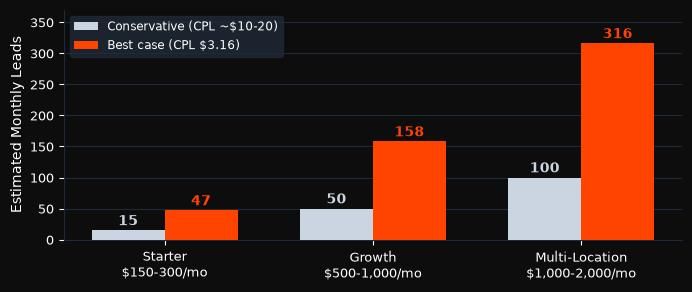
The conversion rate for this format, at 18.25% for restaurants, is far above anything a standard traffic campaign to a website achieves. The cost per lead, as low as $3.16, means that at a $150 monthly budget you can collect 47 qualified local leads per month. At even a 20 percent show rate, that is 9 to 10 new table covers from a spend of $150.
To set up an Instant Form campaign: create a new campaign with the Leads objective in Meta Ads Manager. At the ad level, choose "Instant Form" as the lead method. Build or select a form, add your restaurant name and a short description of the offer, and choose which fields to collect. Name and email are the minimum. Phone number is recommended for reservation confirmation. Preview the form on mobile before publishing.
Budget and What to Expect
Most restaurant owners either overspend on broad campaigns that waste budget or underspend to the point where Facebook cannot gather enough data to optimize. Here is a working framework.
Starting budget: Restaurant marketing benchmarks across 2025 and 2026 consistently recommend a monthly spend of $150 to $300 ($5 to $10 daily) for a single-location restaurant starting out. This is enough to run one Awareness campaign and one Leads campaign simultaneously, each with a tight 5-mile radius. At this budget level, expect to gather meaningful performance data within 14 days.
Growing budget: A monthly budget of $500 to $1,000. At this level, you can run three campaigns (Awareness, Leads, and a retargeting campaign targeting people who have already engaged with your content), test two to three creative variants, and start building statistically significant audience data.
Multi-location: Established multi-location restaurant groups typically allocate $1,000 to $2,000 monthly per location across 2026 Meta campaign benchmarks. Each location needs its own campaign with its own geographic targeting. Do not run a single campaign covering all locations; the targeting becomes too broad to be effective.
ROI benchmark: A well-structured restaurant campaign should achieve a Cost Per Reservation or Lead of $5 to $20. If you are paying more than $25 per lead consistently after the first four weeks, the issue is usually creative quality or targeting breadth. Tighten the radius, refresh the creative, and reduce the audience age range before increasing budget.
What not to do: Do not set a campaign live on a Monday morning with a $500 budget and judge it by Wednesday. Meta's ad delivery system needs time to exit the "learning phase," which requires 50 optimization events in a 7-day window. Smaller daily budgets over longer periods outperform large short bursts for local restaurant campaigns.
Common Mistakes That Kill Restaurant Campaigns
Wrong objective: Using Reach or Engagement when you need Leads or Traffic. This is the single most common mistake. The objective determines how Meta spends your money. Reach and Engagement objectives will get you impressions and likes. They will not get you reservations.
Targeting too broad: Not setting a geographic radius, or setting it at 25 miles for a single-location restaurant. A diner 18 miles away is not going to drive to your restaurant on a Tuesday night. Tight radius targeting means more of your budget reaches people who can actually visit.
No offer in the creative: Generic "Come Dine With Us" ads underperform specific offer-led ads by a significant margin. "Free Dessert This Weekend With Any Main" gives a person a concrete reason to act now. An offer creates urgency without discounting your core menu.
Boosting instead of campaigning: Covered in the earlier section, but worth repeating: Boost is not an ad campaign. It is a reach product. Use Ads Manager for any campaign with a commercial objective.
Ignoring frequency: Running the same creative for 60 days straight. When the same 5,000 people see your ad 12 times in a month, they stop noticing it. Refresh creative monthly at minimum, sooner if frequency exceeds 4.
No follow-up system for leads: Collecting Instant Form leads and not contacting them within 24 hours. Leads go cold fast. Build a simple follow-up process: check your leads daily, call or text within the same day, confirm the reservation or offer. If you cannot do daily lead follow-up manually, set up a Meta notification or integrate your leads with a CRM or email tool.
How Hellyeah's Platform Handles Restaurant Campaigns
Running Facebook ads well requires setting up the campaign correctly, writing copy that drives action, building a form that converts, choosing the right audience, and refreshing creative before it fatigues. For a restaurant owner managing a kitchen and a floor at the same time, that is a lot of moving parts.
Hellyeah's platform handles the build. Hellyeah's AIMA engine creates the Awareness and Instant Forms campaign structure, writes the ad copy, builds the creative brief, sets up the Instant Form, configures local targeting and budget pacing, and auto-places ads across Facebook, Instagram, Messenger, and Audience Network from a single campaign. A person on the restaurant side reviews the plan and approves every launch before it goes live. Every optimization change follows the same approval step. Nothing changes on the account without the owner's sign-off.
For restaurant owners who want the output of a paid media team without hiring one or paying agency fees, this is the direct path. Get started with Hellyeah. It runs on a 5 percent fee of ad spend, not a monthly retainer, so the cost scales with your campaign rather than sitting as a fixed overhead.
The platform connects to your Facebook Page to enable Instant Forms. No website required. No pixel to install. The setup process is handled inside Hellyeah's web platform, not in Ads Manager.
Measuring Whether Your Ads Are Working
Three metrics matter most for a restaurant Facebook campaign in its first 30 days.
Cost Per Lead (CPL): For Leads campaigns, this is the primary metric. Target under $20 CPL for a local restaurant. Under $10 is strong. If CPL is above $25 after two weeks, check targeting breadth and creative relevance first.
Frequency: The average number of times each person has seen your ad. Track this weekly. Above 4 means your audience is too small relative to your budget, or the campaign has been running too long without a creative refresh.
Link Clicks or Form Submissions: For Awareness campaigns, the secondary metric after reach. A click-through rate above 1.5% on a restaurant Awareness campaign is healthy. Below 0.8% means the creative is not connecting with the audience.
What you do not need to obsess over in the first 30 days: ROAS. Restaurant Facebook campaigns are partly direct-response and partly brand-building. A diner who sees your ad six times and then books a table on your fifth week of running the campaign does not show up in 7-day click attribution. Measure leads and reservations holistically, including by asking new customers where they heard about you.
Author's Comment
"Restaurant Facebook ads fail on creative, not targeting. The audience is broad and easy to reach: people within a few miles who have shown interest in food. What breaks campaigns is the creative pipeline. One food image running for six weeks until frequency climbs past eight and everyone who will ever care has seen it twice. I treat creative rotation as an operational rule, not a judgment call. One new creative asset every three weeks, minimum, tested against the control. The restaurants that compound on Facebook treat their creative brief the way an engineer treats a spec: fixed inputs, measurable outputs, scheduled iteration."
Diane, AI Creative Lead, Hellyeah AI
Frequently Asked Questions
How much should a restaurant spend on Facebook ads to start?
Restaurant marketing practitioners recommend starting with a monthly ad spend of $150 to $300, which works out to $5 to $10 daily. This is enough to run one Awareness campaign and one Leads campaign simultaneously with a tight local radius. At this level, you will gather enough data within 14 days to know whether the campaign is working and where to adjust. Do not start with a large budget before the targeting and creative are validated.
Do I need a website to run Facebook ads for my restaurant?
No. Meta Instant Forms capture lead data entirely within Facebook or Instagram, so you do not need a website, a landing page, or a pixel. When someone clicks your ad, a form opens inside the app with their name and contact information pre-filled from their Meta profile. They submit it without leaving Facebook. You receive their details directly and can follow up by phone or email.
What is the difference between boosting a post and running a Facebook ad?
Boosting optimizes for likes, comments, and reach. It is a simple reach product with limited targeting control. Running a proper campaign in Meta Ads Manager lets you choose a commercial objective (Leads, Traffic, or Awareness), control audience radius down to a few miles, build custom and lookalike audiences, and split-test creative. For restaurants trying to fill tables, Ads Manager campaigns consistently outperform boosted posts.
How long does it take for a restaurant Facebook ad to start working?
Meta's algorithm needs time to exit the learning phase, which requires approximately 50 optimization events in a 7-day window. For a small daily budget, this can take 10 to 14 days. Do not judge a campaign in its first week. Give it two weeks of consistent spend before making changes, and only change one variable at a time (targeting, creative, or budget) when you do adjust.
What ad format works best for a restaurant?
Short video (10 to 20 seconds) showing food being made or plated outperforms static images 2 to 3 times in most restaurant campaigns. If video is not available, a single high-quality photo of your best dish in natural light works well. Avoid stock photography. Offer-led ads with a specific, time-limited deal outperform generic brand awareness ads regardless of format.
How often should I change my restaurant Facebook ad creative?
Refresh creative every 3 to 4 weeks. When your ad frequency rises above 3 to 4, the same people have seen it multiple times and performance drops. You do not need to rebuild the campaign. Swap the image or video while keeping the targeting and objective intact. If you are running ads actively, tracking frequency weekly gives you an early warning before costs start rising.
Related blog posts

AI creative lead
AI creative lead at Hellyeah, focused on creative direction: how the work gets generated, critiqued, and shipped.


