

On this page
Dentists who run Google Ads and book patients from them are measuring the same thing: booked appointments, not clicks. The average dental practice pays $8.00 per click and $72.97 per lead, but the ones getting 10 to 16 new patients a month are tracking conversions that actually tie to revenue. The structure matters. The measurement matters more.
Quick Answer
- Dental Google Ads work best as three separate campaigns: emergency, new patient, and high-ticket procedure. Each serves different intent and should not share a budget.
- The 2026 industry benchmark is $72.97 per lead and 10.67% conversion rate, but effective cost-per-new-patient runs $150 to $300 when tracking is set up correctly.
- Smart Bidding only works once you hit roughly 30 conversions per month. Below that, Max Clicks on a tight radius gives you more data without wasting spend on automated bidding that has nothing to learn from.
Why Google Ads Works for Dental Practices
Search intent is the reason. Someone typing "emergency dentist near me" or "dental implants [city]" has already decided they need care. They are not browsing. They are not comparing blogs. They are looking for a phone number.
That is a fundamentally different conversion environment than social media, where your ad interrupts someone scrolling photos. Google search puts your practice in front of patients at the exact moment they are ready to book. That is why dentistry has a 10.67% conversion rate from click to lead , roughly 2.3x higher than industries like technology or finance where the buyer still needs to be educated on the problem.
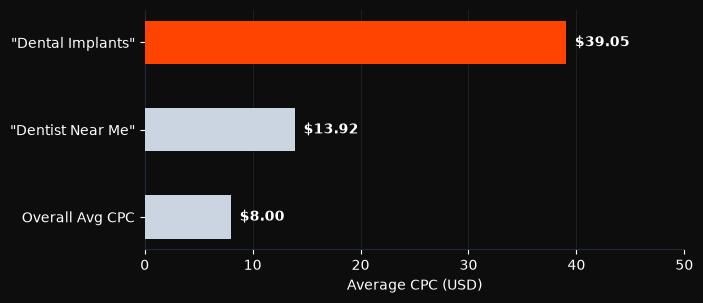
The catch is that high intent also means high competition. A click on "dental implants near me" costs $39.05 on average. "Dentist near me" runs $13.92. These are not passive awareness costs , they are the price of being visible to a patient who is already at the decision point. Spend it wrong and you get clicks from people researching DIY teeth whitening or looking for dental school clinics. Spend it right and you get the phone ringing with patients who have insurance and want to book this week.
The math works when the campaign is structured around patient lifetime value, not click cost. A new patient is worth $700 to $1,500 in year one, according to WordStream industry benchmarks. An implant patient is worth $3,000 to $6,000 for a single case. Against those numbers, a $200 cost-per-new-patient is a good trade even in a competitive market.
Dental Google Ads convert at 10.67% on average , roughly 2.3x the all-industry average of 8.18%. The 2026 benchmark from 13,474 US campaigns (sourced from LocaliQ's Google Ads Benchmarks report) shows the median dentist pays $72.97 per lead and $8.00 per click. New patient lifetime value runs $700 to $1,500 in year one, and implant cases bring $3,000 to $6,000. At a $200 cost-per-new-patient, Google Ads pay for themselves in roughly 3.5 to 7.5 patients per month, depending on your service mix. The key: track booked appointments as the conversion event, not page views or phone calls that never get answered.
The Three-Campaign Structure That Books Patients
Most failing dental accounts have one problem in common: all their services share one campaign. Emergency patients, implant leads, and Invisalign inquiries are all fighting for the same budget, the same keywords, and the same ad copy. The result is averaged performance , and averaged performance hides which services are actually working.
The structure that works is three separate campaigns inside a five-to-seven-mile radius from your practice.
Emergency Dental Campaign
Emergency patients search "tooth pain relief," "emergency dentist near me," and "same-day dental appointment." They are in pain, they are searching now, and they will call whoever answers first. No other dental campaign type converts as fast as emergency.
Set this campaign to Max Clicks while you accumulate conversion data, then switch to Target CPA once you hit 30 or more conversions per month. Start with a tight 5-mile radius , emergency patients rarely drive across town. Keep budget separate because emergency leads are disproportionately valuable: these patients often become long-term patients for cleanings, x-rays, and future procedures.
Keywords to bid on: "emergency dentist near me," "tooth pain [city]," "dentist open now," "same day dental appointment," "cracked tooth [city]." Match type: phrase match to control spend without missing variations.
New Patient and General Campaign
High volume, lower intent urgency. This campaign captures "family dentist in [city]," "dentist accepting new patients," and "dentist near me." These patients are comparing practices, so your ad copy and landing page carry more weight here than in the emergency campaign.
Budget goes here first, because volume matters. Target at 7 miles if your market density supports it. Run responsive search ads with at least 8 headlines and 4 descriptions, using your practice name, the neighborhood, and a booking offer in rotation.
High-Ticket Procedure Campaign
Implants, Invisalign, veneers, and full-mouth restorations each need their own ad group at minimum, or their own campaign if the procedure is a significant revenue driver. The reason: a patient searching "dental implants [city]" has a different lifetime value profile than a new patient searching "dentist near me." Mixing them means your CPA target will never be calibrated correctly for either.
For implants specifically, a $39.05 click (per LocaliQ 2026 benchmark data) still yields a positive ROI against a $3,000 to $6,000 case value. Budget $800 to $1,200 monthly for implants alone if they are a practice priority , enough to generate 20 to 30 clicks per day in most markets at benchmark CPCs.
Budget and Cost-Per-Patient Math
Here is the budget math that most guides skip. Rather than stating a range, work backward from how many new patients you need.
| Monthly budget | Clicks (at $8.00 CPC) | Leads (at 10.67% CR) | New patients (at 40% book rate) | Cost per new patient |
|---|---|---|---|---|
| $1,500 | 188 | 20 | 8 | $188 |
| $2,000 | 250 | 27 | 11 | $182 |
| $3,000 | 375 | 40 | 16 | $188 |
| $5,000 | 625 | 67 | 27 | $185 |
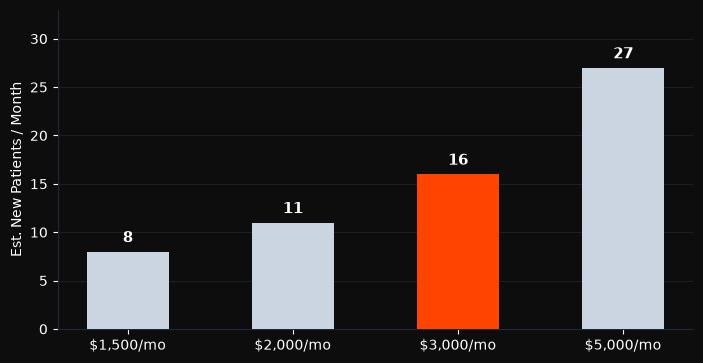
These are benchmark calculations using industry averages. Your actual CPC will vary by market size and procedure mix. Solo practices in smaller markets often pay 30 to 50% less per click than practices in major metros. Competitive metros like New York or Los Angeles can see CPCs two to three times the national average.
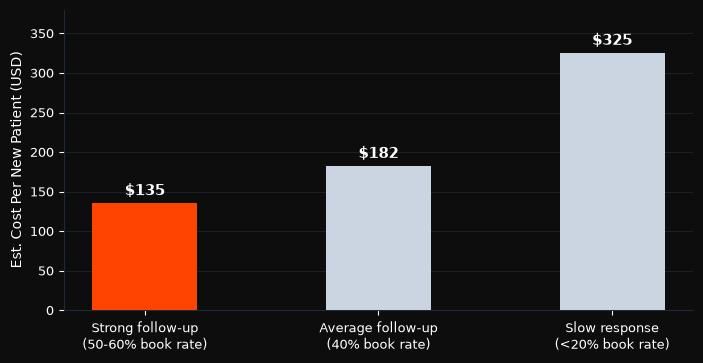
A 40% booking rate is a reasonable planning assumption , that is, 40% of leads who complete a form or call actually book an appointment. Practices with strong front-desk follow-up and same-day callback protocols often hit 50 to 60%. Practices where leads sit in an inbox for 24 hours often see 20% or less.
The 90-day rule. Budget for 90 days before evaluating performance. The first 30 days is data collection. Days 30 to 60 is the Smart Bidding learning period once you switch from Max Clicks. Days 60 to 90 is when the algorithm starts making predictions from real conversion data and your cost-per-patient stabilizes.
Keywords That Bring Patients, Not Browsers
Dental keyword selection has one primary job: filter out the people who will never become patients.
High-intent keywords to bid on by procedure:
- Emergency: "emergency dentist near me," "tooth pain [city]," "dentist open Saturday"
- General: "dentist near me," "dentist in [neighborhood]," "family dentist accepting new patients"
- Implants: "dental implants [city]," "tooth implant cost [city]," "all-on-4 dental implants"
- Invisalign: "Invisalign near me," "Invisalign provider [city]," "invisible braces [city]"
- Cosmetic: "teeth whitening [city]," "dental veneers [city]," "smile makeover dentist"
Negative keywords to add from day one:
| Category | Examples |
|---|---|
| Job seekers | dental assistant jobs, dental hygienist positions, dentist salary |
| DIY / informational | how to pull a tooth, tooth pain home remedy, dental school free |
| Insurance / free | free dental implants, dental implants on Medicaid, no insurance dentist |
| Irrelevant services | dental supplies, dental equipment, dental software |
| Out-of-area | keywords with city names outside your service radius |
Match types: Start with phrase match for control. Broad match with Smart Bidding can be introduced after 60 days of data. Exact match on your highest-converting terms once you have identified them from the search terms report.
Every week, pull the search terms report and add irrelevant terms to your negative keyword list. This single habit accounts for most of the difference between dental accounts that improve over time and ones that plateau.
Local Services Ads vs Search Ads for Dentists
Local Services Ads (LSAs) now include Dentist and Orthodontist as eligible categories in the US. They appear above standard search ads with a "Google Screened" badge and operate on a pay-per-lead model rather than pay-per-click.
The key difference: LSAs are optimized for "I need someone now" intent. Search Ads give you control over keywords, ad copy, landing pages, and bidding strategy. The recommended approach for most dental practices is to run both, but with separate roles.
| Format | Best for | Lead cost estimate | Control level |
|---|---|---|---|
| Local Services Ads | Emergency, general availability, "near me" queries | ~$100-$150 per lead | Low (Google controls targeting) |
| Search Ads | All campaigns: emergency, new patient, procedures | $73-$200 per lead | High (you control keywords, bids, copy) |
One important policy note: healthcare ads in Google are marked "Eligible (limited)" for personalized targeting under Google's personalized advertising policies. This means you cannot retarget website visitors or use custom audience segments based on health-related browsing behavior. For most dental practices, this is not a significant constraint , your acquisition runs through new searches, not retargeting loops. But it does mean you will not recover dropped visitors through display remarketing the way an ecommerce brand would.
The Google Screened badge for LSAs requires a background check, license verification, and insurance verification through Google's process. This takes 2 to 6 weeks to complete, so if you plan to run LSAs, start the verification process before you are ready to go live.
Tracking That Counts Booked Patients, Not Clicks
Most dental Google Ads accounts break down at measurement. Smart Bidding is a feedback machine, learning from the conversions you designate. If you tell it to optimize toward "page views," it finds cheap page views. If you tell it to optimize toward "phone calls lasting more than 60 seconds," it finds calls that match that behavior.
The right conversion events to import into Google Ads are:
- Phone calls lasting 60+ seconds (configured via Google Ads call tracking or a third-party tool)
- Contact form submissions (via GA4 event or Google Tag)
- Online booking completions (via your booking software's confirmation page, if accessible)
Setting up GA4 for dental practices: Create goals for each of these three events and import them into Google Ads as primary conversion actions. Set up enhanced conversions to improve match rates. Do not import session starts or page views as conversion events , they will skew your bidding toward traffic that never converts.
A note on call tracking and patient data. Standard call tracking tools that record calls or log call content alongside patient information can raise HIPAA concerns. If your practice collects patient health information over the phone and uses a third-party call tracking provider, confirm that the provider signs a Business Associate Agreement (BAA) and that recorded calls are not stored in environments that could link back to a specific patient's health information. For basic call tracking (call count, duration, source), Google Ads' built-in call tracking does not record call content and is generally considered low-risk. This is not legal advice , consult your practice's compliance advisor for your specific setup.
Dental practices should import three conversion events into Google Ads: phone calls lasting 60 or more seconds, contact form submissions, and online booking completions. Do not import page views or session starts as conversions , Smart Bidding will optimize toward whatever you measure, and cheap page views are not patients. Google Ads' built-in call tracking counts call duration without recording content, making it a lower-risk starting point for practices concerned about HIPAA. Third-party tools that record call content alongside patient information should have a signed Business Associate Agreement in place. Set up conversions in GA4 first, then import to Google Ads, and wait for at least 30 conversions before switching to Target CPA bidding.
How to Use Google Lead Forms Without a Landing Page
Most guides assume you have a website, a landing page, and a developer who can install a Google Tag. Many solo dental practices do not , or they have a website that was built five years ago and converts poorly.
Google's lead form extensions (also called Instant Forms) solve this. When a user clicks your ad, a form opens directly in the Google search results page. They enter their name, phone number, and email address , Google pre-fills this from their account data, which means a patient on their phone can submit a lead in under 10 seconds without ever visiting your website.
Lead form submissions go to a CSV you download from Google Ads, or you can connect them to a CRM via a webhook. You are paying per click, not per form submission, but the friction reduction is significant. Mobile users convert at much higher rates on lead forms than on landing pages because there is no loading time and no form to navigate on a small screen.
The practical setup: create a lead form as an asset in Google Ads, attach it to your campaign as an asset, and set your campaign's lead form asset to collect name, phone number, and appointment interest (general/emergency/procedure). When a lead comes in, call them within 2 hours. The faster your callback time, the higher your booking rate.
This approach also sidesteps the HIPAA-related complexity of third-party tracking tools, since Google handles the lead form data under its own terms of service. You collect contact information, not health information, in the form itself.
Four Mistakes That Drain Dental Ad Budgets
These four patterns account for most of the underperformance in dental accounts that I see.
1. Sending traffic to the homepage. Your homepage is not a landing page. It has navigation, service descriptions, about pages, and staff bios. A patient who clicks an ad for "dental implants near me" and lands on a homepage has to find their own way to the implant service page. Most will not. Dedicated landing pages , one per procedure or campaign type , consistently outperform homepage traffic by 2 to 4x on conversion rate.
2. Bidding on "cheap" keywords. Keywords like "affordable dentist" and "cheap dental care" attract patients who are primarily price-shopping and are unlikely to proceed with premium procedures. These keywords often have low CPCs but terrible patient quality. Exclude them.
3. Running one campaign for all services. As described in the campaign structure section, mixing emergency, new patient, and procedure campaigns means none of them have the right budget allocation, bid strategy, or conversion signal. Separate them.
4. Skipping the search terms report. Google's broad and phrase match keywords will trigger searches you did not anticipate. A keyword like "dentist near me" might also trigger "dental school near me" or "veterinary dentist near me." Pull the search terms report weekly, identify irrelevant queries, and add them as negatives. This one habit reduces wasted spend faster than any bid adjustment.
How Hellyeah Runs Dental Google Ads Campaigns
For dental practices that want campaigns built and running without the setup overhead, Hellyeah's platform handles the full workflow. The Hellyeah platform, powered by AIMA, builds your campaign structure, writes ad copy, sets up lead form assets, handles keyword research, and runs targeting , all from a single dashboard.
For dental lead generation specifically, Hellyeah's Leads objective on Google works without a tracker install. AIMA sets up a Google lead form as the conversion event, so patients submit their contact information directly in search results and leads arrive in your Hellyeah Leads inbox. You see every lead, can assign an owner, and qualify them without a CRM integration.
Hellyeah's flat 5% management fee means a dental practice spending $2,000 monthly on ad spend pays $100 monthly for full campaign management, keyword research, ad copy, and AIMA optimization. No agency contract. No minimum term. Start from a $50 balance and scale when results arrive.
For practices with existing campaigns that are not performing, Hellyeah's X-Ray analytics surface where budget is going and which keywords are actually producing leads versus just generating clicks.
Author's Comment
"The dental accounts I see fail make the same error: they treat Google Ads as a traffic system when it is really a signal processing system. Smart Bidding needs clean conversion data the way a feedback loop needs a clean signal. Garbage in, garbage out. The fix is not more budget , it is telling the algorithm to optimize toward patients who actually show up, not toward whoever clicks cheapest."
Jay Ma, Co-Founder, Hellyeah AI
FAQ About Google Ads for Dentists
How much should a dentist spend on Google Ads per month?
Solo practices in smaller markets can start at $1,000 to $1,500 monthly and expect 8 to 10 new patients based on LocaliQ 2026 dental benchmark data. Practices targeting high-ticket procedures like implants or Invisalign in competitive metros typically need $3,000 to $5,000 monthly to generate enough click volume for Smart Bidding to learn from, given average dental CPCs of $8.00 and the 30-conversion threshold for Target CPA. Budget for 90 days before evaluating , the first month is data collection, not results.
How long does it take for dental Google Ads to produce patients?
You can get calls within 48 to 72 hours of a live campaign. However, the first 2 to 4 weeks are the data collection phase, and Smart Bidding does not stabilize until roughly 60 days in and 30+ conversions in. Most practices see their true steady-state cost-per-patient between weeks 8 and 12.
What is a good cost per new patient from Google Ads?
The benchmark target is $150 to $300 per new patient. At a 10.67% click-to-lead conversion rate and a 40% lead-to-booking rate, a $72.97 cost per lead translates to roughly $182 per booked patient. Practices with strong front-desk follow-up often land at $120 to $150. Practices with slow lead response often run $250 to $400.
Can dentists run remarketing ads on Google?
Standard display remarketing is significantly limited for healthcare advertisers due to Google's personalized advertising policies, which restrict targeting based on health-related behavior. General dentistry is not classified as a sensitive health condition, so you can run some remarketing. However, you cannot use remarketing lists based on dental-topic page visits for most audience types under Google's personalized advertising policies for sensitive categories. In practice, most dental practices are better served by search campaigns than by remarketing display.
Are Google Local Services Ads worth it for dentists?
Yes, for emergency and availability queries. LSAs appear above standard search ads, include a Google Screened badge, and charge per lead rather than per click. The verification process (background check, license, insurance) takes 2 to 6 weeks. Lead costs typically run $100 to $150 per lead. Run LSAs alongside Search Ads rather than instead of them , they serve different intent signals and capture different patient segments.
Should a dentist manage Google Ads themselves or hire someone?
A dentist managing ads themselves will spend 5 to 10 hours per month on account work if they do it properly. The risk is not incompetence , the risk is not having time to do it consistently. Google Ads requires weekly search term reviews, bid adjustments, ad copy tests, and conversion tracking maintenance. When that work slips, performance degrades quietly. Hiring a specialist or using a platform that handles the operational layer makes sense once monthly ad spend crosses into the range where the 5 to 10 weekly management hours represent a meaningful opportunity cost for a practicing dentist , typically around $1,500 or more in monthly spend based on standard dental benchmark CPCs.
Related blog posts

Co-founder
Co-founder of Hellyeah. Writes about building durable growth loops that compound over time.


