

On this page
Solo attorneys in estate planning, family law, and criminal defense can run profitable Google Search campaigns on $1,000-$2,500 a month. The guides saying you need $15,000 monthly are written for personal injury firms in major metros. Your practice area has CPCs of $8-35, not $150, and the math is completely different. As of 2026, Google Ads remains one of the most direct channels for small law firms to reach clients searching for legal help right now.
Quick Answer
- Google Ads works for small law firms in estate planning, family law, immigration, and criminal defense, where CPCs run $8-50 rather than the $60-250 seen in personal injury.
- Solo attorneys can start with $1,000-$2,000 a month by running Search-only campaigns, using exact and phrase match keywords, with a Google Lead Form that captures inquiries directly rather than sending clicks to a website.
- The biggest account drain is review cadence: at legal CPCs of $10-50, an unmanaged account can exhaust a day's budget on low-intent morning searches before high-intent evening queries arrive, which is why bid management needs to run on a daily or intraday basis, not a weekly schedule.
The Practice-Area Fit Test for Small Law Firms
The first question is not "how do I set up a Google Ads account?" It's "does my practice area even make sense for Google Search campaigns at the budget I can actually sustain?"
Most small firm Google Ads guides skip this question entirely. They present a single CPC range that reflects personal injury in Los Angeles, then tell you to budget $5,000-$15,000 a month. That guidance is useless to a two-attorney estate planning firm in Columbus.
Practice areas where the math works at small-firm budgets
These practice areas have CPCs that make $1,000-$3,000 a month viable, based on LocaliQ 2024 legal benchmark data compiled in the StubGroup legal guide across thousands of active legal accounts:
- Estate planning and wills: $10-35 average CPC. At a 10% click-to-lead rate and a 25% lead-to-signed rate, 100 clicks at $20 each ($2,000 spend) produces roughly 2-3 signed clients. If your average will/trust package runs $2,500-6,000, you're looking at $5,000-$18,000 in billed revenue from that spend.
- Family law (divorce, custody, prenups): $15-50 average CPC. More competitive than estate planning but still workable. Target narrow practice subtypes like "prenuptial agreement attorney" rather than "divorce lawyer" to stay at the lower end of the range.
- Immigration: $9-15 average CPC. Low competition in most markets outside major metros. Visa and green card queries convert well because there's clear intent.
- Criminal defense and DUI: $25-80 average CPC, with DUI sitting lower. Geography matters more here: a suburban DUI attorney can stay under $40 CPC; downtown Atlanta criminal defense will push $70+.
- Bankruptcy: $11-12 average CPC nationally. High conversion rates (13.56% in LocaliQ data) and clear intent signals.
Practice areas where Google Search rarely pencils out for a solo firm
- Personal injury: Average CPC in major metros runs $60-250+ per click. A solo PI attorney competing in Chicago or Miami for "car accident lawyer" will burn through $10,000 a month before seeing a single signed case. National PI benchmarks are not your numbers.
- Medical malpractice: CPC of $50-150+ and extremely long sales cycles. Leads rarely convert to signed cases quickly enough to justify the spend for a small firm.
- Class action litigation: Even when CPCs are lower, the client intake model doesn't match the ad-driven lead flow.
Working through the numbers using LocaliQ 2024 legal benchmarks (estate planning average CPC $7.92-$25, 9.65% conversion rate), $1,800 in Google Search spend at $18 average CPC produces roughly 100 clicks, 10 leads, and 3 signed clients at a 25% lead-to-signed rate. If an average estate planning engagement runs $2,000-$4,000, that spend returns $6,000-$12,000 in billed revenue, a 3.3x-6.7x return before overhead. This math is absent from every general Google Ads for lawyers guide because those guides are written for personal injury firms where a single case is worth $50,000+.
The practice-area fit test is simple: if your average case fee is at least 5x your expected cost-per-case (clicks divided by your lead-to-signed conversion rate), Google Ads has a reasonable path to profitability. If it isn't, look at Google Local Services Ads instead, where you pay per verified lead rather than per click.
What Google Search Campaigns Actually Cost for Small Firms
Before you open Google Ads Manager, understand that legal is the most expensive industry on Google Ads, averaging $9.87 per click according to WordStream's 2026 analysis of 17,000+ campaigns. That average is heavily skewed by personal injury. Your practice area CPC will be very different.
Real CPC ranges by practice area
| Practice Area | Avg CPC (National) | Small Market CPC | Monthly Budget for 100 Clicks |
|---|---|---|---|
| Estate planning | $12-25 | $8-15 | $1,200-2,500 |
| Immigration | $9-15 | $6-10 | $900-1,500 |
| Bankruptcy | $10-13 | $8-11 | $1,000-1,300 |
| Family law | $15-35 | $10-20 | $1,500-3,500 |
| Criminal/DUI | $25-60 | $15-35 | $2,500-6,000 |
| Personal injury | $60-250+ | $30-90 | $6,000-25,000+ |
Sources: LocaliQ 2024 legal benchmarks; StubGroup client data; BigDog ICT practice-area analysis.
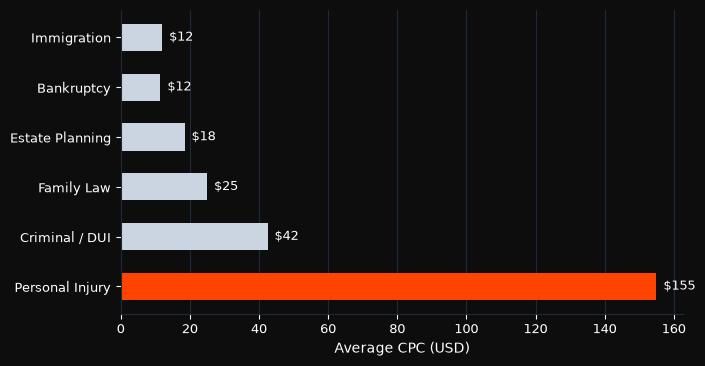
These ranges assume you're targeting your specific city or metro, not statewide or national. Tightening your location targeting is the single fastest way to reduce CPC in competitive markets.
The cost per acquisition math that matters
Clicks are not the metric that decides whether Google Ads works for your firm. Signed cases at a cost that leaves margin are the metric. Work backward:
- What's your average case fee? ($2,000 for a will, $5,000 for a trust package, $3,500 for a contested divorce, $1,500 for a DUI defense)
- What's the maximum you can spend to acquire one client and still keep 60% margin?
- What's your realistic lead-to-signed rate? (Most small firms run 20-35% across practice areas)
- Divide your max cost-per-client by your lead-to-signed rate to get your max cost-per-lead
- Divide that by your expected click-to-lead rate (8-12% for a well-matched landing page) to get your max viable CPC
If your max viable CPC is higher than the practice-area CPC range above, Google Search is viable for you. If it isn't, you need either a higher-converting intake process, a more efficient landing page, or a different channel.
Use Hellyeah's ROAS calculator to run this math for your specific case values before setting a budget.
7 Google Search Campaign Steps That Avoid Common Mistakes
These steps apply to a solo or small firm running a single practice area in one city or metro. They're ordered by what goes wrong most often, not by where Google Ads Manager takes you through the setup.
Turn Off Display Network and Search Partners First
When you create a new Search campaign, Google pre-checks both "Google Display Network" and "Google Search Partners." Uncheck both. Search Partners spend your budget on sites that run Google search results, which in legal tends to mean Justia, Avvo, and similar directories where your ad competes with other law firm ads and directory listings. Display Network puts image ads on non-search pages, which is the wrong intent entirely for someone who needs a lawyer now.
These two settings alone account for an estimated 15-30% of wasted spend on law firm campaigns that skip the audit phase.
Set Up Conversion Tracking Before Your First Click
Do not spend a dollar until you're tracking conversions. For small firms, the easiest setup is the Google Lead Form asset, which collects name, phone, and email inside the Google search result before the user even reaches your site. Leads come directly into your Google Ads account and, if you're using Hellyeah, into your Leads dashboard automatically.
If you prefer a website form, use the enhanced conversions for leads setup, which imports signed cases (not just form submissions) as offline conversions. Rankings.io calls signed-case conversion tracking the most important step because optimizing for form fills trains Google's algorithm on the wrong signal when those form fills never convert to clients.
Why Exact and Phrase Match Only Protects Your Budget
Broad match for legal keywords is a budget fire. "Lawyer" in broad match will trigger your ad for "lawyer jokes," "become a lawyer," and "lawyer salary." Build your keyword list around case-intent queries in exact and phrase match:
- [exact match: divorce attorney Columbus Ohio]
- [phrase match: "estate planning lawyer near me"]
- [exact match: DUI attorney first offense]
Learning how quality score cuts your effective CPC matters here: tightly matched keywords that align with your ad copy and landing page earn higher Quality Scores, which lowers the CPC you actually pay at auction even when competitors bid higher.
Build Your Negative Keyword List Before Launch
Add these to your negative keyword list before your campaign goes live:
- law school, paralegal, legal intern, lawyer jobs, lawyer salary
- free legal advice, pro bono, legal aid
- [competitor firm names] if you don't want competitor keyword traffic
- words that describe the opposing party, not a potential client (e.g., "sue my employer" triggers "employer lawsuit attorney" ads for the wrong person)
A well-structured negative list is what separates a $2,000/month campaign that produces clients from one that produces unqualified calls.
Write Responsive Search Ads That Pass Bar Review
Google's advertising policies require that claims are truthful and not misleading, but state bar advertising rules are stricter than Google's policies. Google approval is not a compliance defense. For your ads:
- Do not claim results (no "We won $50M in settlements") unless your state bar rules explicitly permit it
- New York requires the label "Attorney Advertising" somewhere in the ad
- Florida requires filing ads for review before publication in some cases
- California prohibits claims that are untrue, confusing, deceiving, or misleading under any reading
Check ABA Model Rule 7.1 and your specific state bar's advertising rules before writing headlines. The best practices for writing responsive search ads on a small budget apply here: test 3-4 headline combinations that frame client outcomes without making result claims.
Send Clicks to a Practice-Specific Landing Page
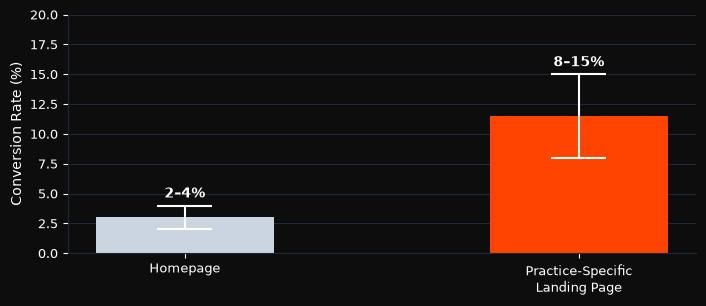
Every practice area campaign gets its own landing page with copy that matches the keyword, the ad headline, and the specific service. "Estate planning attorney in Columbus" clicks should not land on a homepage that lists five practice areas and a firm overview.
Landing pages built around a single practice area and a single call to action convert at 8-15%. Homepages convert at 2-4%.
Review the Account on a Fixed Weekly Schedule
Weekly search term reviews, bid adjustments, and negative keyword additions: these are the minimum. For legal campaigns at high CPCs, a poorly performing search term can cost $100-200 before you catch it if you only check once a week.
For high-CPC accounts, smart bidding strategies designed for small accounts shift the daily optimization burden off your plate. Target CPA bidding with a set cost-per-lead ceiling stops the algorithm from bidding $150 per click when you've set a $30 maximum, without requiring you to log in and adjust manually every morning.
Author's Comment
"Law firm Google Ads accounts are where I see the human-versus-automation decision mishandled most often. Attorneys default to manual control over everything because the stakes per lead are high, and that instinct is right for bid floors and search term approvals. But they apply the same manual control to ad copy testing, which is exactly where automation compounds. Responsive search ads with a tightly controlled asset pool, limited headline and description variants all reviewed by the attorney, gives the algorithm room to test while keeping brand voice consistent. Expose what benefits from automation. Lock what requires human judgment."
Yulong He, Product, Hellyeah AI
Why the 5-Minute Intake Rule Breaks Down for Solo Attorneys
The research is consistent: leads contacted within 5 minutes are 21 times more likely to qualify than leads contacted after 30 minutes, according to LawRank's analysis of lead response data. The average law firm takes over two business days to respond.
This statistic is cited in every major Google Ads for lawyers guide. None of them explain what to do about it when you're a solo attorney in court from 9am to 4pm.
What happens when you're unavailable to answer
A prospect searching "estate planning attorney near me" at 2pm on a Tuesday clicks your ad, lands on your contact form, and submits their name and number. You're in a three-hour deposition. By the time you see the notification at 5:30pm, that prospect has already called two other firms and booked a consultation with the one that answered.
The intake bottleneck is not a marketing problem. It's a capacity problem that paid media makes more visible.
Lead Form objective as a structural fix
Google's Lead Form objective captures name, email, and phone inside the search result. No landing page required. Leads go directly to your Google Ads account and, if your campaign runs through Hellyeah, into a Leads dashboard where you can assign follow-up, set a reminder, and see the full lead history.
This doesn't solve the 5-minute response problem; you still need someone to follow up. But it eliminates the second failure mode: the prospect who fills out a website form and never receives a confirmation email because the form submission went to a spam folder.
For a solo attorney, the Lead Form approach paired with an automated confirmation text or email is the minimum viable intake system. Set the confirmation to go out immediately via your CRM or even a Google Ads webhook integration. Then batch your callbacks at defined times: 12:30pm during lunch and 5:30pm after court.
The how ad budget allocation across Google and Meta changes when you add lead forms goes deeper on this if you're running multiple channels alongside Search.
What $2,000 a Month Buys with DIY vs a Platform
The honest answer to "should I manage my own Google Ads?" depends on one number: how many billable hours a month you spend managing the account instead of practicing law.
The breakeven hourly cost of self-management
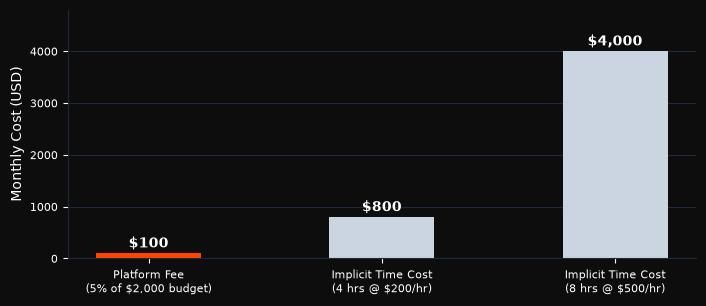
Most small firm owners who manage their own Google Ads spend 4-8 hours a month on search term reviews, bid adjustments, ad copy testing, and negative keyword updates. For context on billing rates, industry surveys such as the Clio Legal Trends Report report typical solo practitioner rates of $200-$500 per hour. At that range, 4-8 hours of account management represents $800-$4,000 in implicit time cost on a $2,000 campaign.
When the time cost of self-management approaches the budget itself, you're not saving money; you're paying twice. The full breakdown of what PPC management actually costs covers the comparison across in-house, agency, and platform models.
Running through a small-account audit checklist quarterly is the minimum viable self-management routine. If you can't complete the audit in under an hour, the account has grown beyond efficient self-management.
What Hellyeah's platform handles automatically for service businesses
Hellyeah's AIMA platform handles the repetitive optimization work that eats the most billable hours for self-managing attorneys:
- Daily bid adjustments based on conversion data (no manual login required)
- Budget pacing to prevent overspending before high-intent hours of the day
- Search term reviews and automatic negative keyword suggestions
- Ad copy performance tracking across your RSA headline combinations
- Lead form integration so inquiries appear in a single dashboard alongside campaign spend
What AIMA does not replace is the strategic decisions: which practice areas to add, whether to expand geo targeting, how to adjust the approach if sign-up rates drop. A person reviews and approves every significant change. You stay in control of the decisions that shape the campaign; the daily execution runs without your manual input.
For a solo attorney managing a $1,500-$3,000 Search campaign, the 5% platform fee is $75-$150 a month. Compare that to the 2-4 hours of billable time you'd otherwise spend on account management each week.
The "Solo Firm Flywheel" is a four-stage Google Search campaign system for attorneys running $1,000-$3,000 a month: Stage 1 is Narrow Focus, meaning one practice area, one metro, one client profile. Stage 2 is Search Only, running exact and phrase match with Display Network and Search Partners turned off. Stage 3 is Lead Form capture, using Google's Lead Form objective so inquiries arrive in a dashboard rather than a website form that waits for a response. Stage 4 is AIMA Automation, where daily bid management and search term reviews run without weekly manual check-ins. Each stage eliminates a specific failure mode that solo attorneys face. Together they produce a campaign that scales with signed cases rather than with the attorney's available attention.
The Hellyeah platform for Google Ads runs Search campaigns and Google Performance Max for Lead objectives. For a small law firm testing Google Search for the first time, the Search-only setup is the right starting point until you have 90 days of conversion data.
Frequently Asked Questions About Google Ads for Lawyers
Do Google Ads work for solo attorneys?
Yes, in practice areas where the CPC-to-case-value math works. Estate planning, immigration, bankruptcy, and criminal defense are the most accessible. Personal injury in competitive metros is usually not viable for a solo firm without a $15,000+ monthly budget.
How much should a small law firm budget for Google Ads?
$1,000-$2,500 a month is a workable starting range for estate planning, immigration, and family law in mid-size markets. $2,500-$5,000 works for criminal defense and DUI. Below $1,000, you'll get fewer than 50-100 clicks a month, which is not enough data for the Google algorithm to optimize your bids effectively.
What is a good cost per signed case for a law firm?
Work backward from your practice area economics. An estate planning attorney who charges $3,000 for a trust package can afford up to $1,500 in acquisition cost and still keep 50% margin. A family law attorney with $5,000 retainers can afford up to $2,500. The number is unique to your billing model, not a universal benchmark.
Should small law firms use Performance Max campaigns?
Not at first. Performance Max works best with strong conversion data (30+ monthly conversions in a specific account). A new small-firm campaign should run Search only for 90 days, build conversion history, then evaluate PMax for the Lead objective. Starting with PMax on a small budget produces uncontrolled spend with no visibility into where clicks are going.
What Google Ads mistakes waste the most budget for law firms?
In order of budget impact: (1) leaving Display Network checked on Search campaigns, (2) running broad match keywords, (3) sending all clicks to the homepage instead of a practice-specific landing page, (4) tracking form fills instead of signed cases, and (5) checking the account weekly instead of daily when CPCs are high.
How long before a new Google Ads campaign produces consistent leads?
60-90 days for the algorithm to accumulate enough conversion data to optimize bids effectively. Budget for the first 30 days as a data-collection period with few or no signed cases. Campaigns launched correctly by week 8-12 typically reach a stable cost-per-lead that you can project forward.
Can lawyers in all states advertise on Google?
Yes, Google permits attorney advertising as a category. But Google's advertising approval is not a compliance defense under state bar rules. Check your state bar's specific rules for lawyer advertising before running any ad. ABA Model Rules 7.1 and 7.2 permit advertising in any medium, but states like Florida, New York, and California have additional requirements around disclaimers, filing, and prohibited claims.
Related blog posts

Product
Product at Hellyeah. Designs the surface where people and automation share a workspace: what to expose, what to automate, what to leave alone.


