

On this page
The in-house versus agency debate has run for decades. Each side has a real argument. In 2026, a third option has moved into the mainstream and most comparisons still do not include it: an AI marketing platform that handles campaign execution at a fraction of what agencies charge and without the hiring risk of building an in-house team.
This guide compares all three models across cost, speed, control, and performance quality, then gives a decision framework based on where your team actually is.
In-house teams offer control and brand depth but take 3 to 6 months to ramp and cost $80K to $150K+ per hire annually. Agencies deliver speed and specialization at $2K to $15K per month but carry account manager turnover risk and opaque media markup structures. AI platforms like Hellyeah run campaigns at a 5% fee on managed spend with transparent costs and AIMA-driven optimization that does not require dedicated headcount.
What each model actually looks like in practice
Before the comparison, it helps to be specific about what you are actually buying in each case.
| Model | You are paying for | Knowledge depth | Time to launch | Cost structure |
|---|---|---|---|---|
| AI platform (Hellyeah) | Software with an AI execution layer handling campaign operations | Real-time performance signals from your own account data | Days from onboarding | Percentage of managed spend, no markup |
| In-house | A dedicated employee who owns performance marketing | Deep product and brand knowledge over time | 3 to 6 months from hiring to productivity | Fixed salary, benefits, tools |
| Agency | A shared team of specialists across multiple client accounts | Cross-client pattern recognition and channel certifications | 2 to 3 weeks from contract signing | Retainer plus media markup |
In-house performance marketing: You hire one or more people to own paid acquisition directly. They know your product, your customers, and your brand position with a depth that no external team can match quickly. They sit in your team standups, see your product roadmap, and can react to news or market shifts without an account briefing. The cost is salary, benefits, tools, and the time cost of recruiting and onboarding. The risk is that their skills may not cover every channel you need, and replacing them if they leave is expensive and slow.
Performance marketing agency: You pay a retainer for a team of specialists who work across many client accounts. They bring channel expertise and a tested playbook. The account manager assigned to you may be strong or weak depending on the firm's staffing decisions that week. Agencies frequently mark up media spend by 15 to 20% beyond their management fee, which many clients only discover when they get direct API access to their accounts.
AI marketing platform: Software plus an intelligent engine handles campaign execution: building account structures, generating creative variants, managing bids, and optimizing in real time based on performance signals. Human strategic input is still required. The platform does not decide what your offer should be or who your target customer is. But it replaces the execution layer that agencies and in-house managers typically spend most of their time on, at a cost structure that scales with your spend rather than with headcount.
In-House Performance Marketing
| Metric | In-house (one senior hire) |
|---|---|
| Time to full productivity | 3 to 6 months from job posting |
| Annual cost | $90K to $130K plus benefits, equity, and tools |
| Channel coverage | Limited to individual expertise; expands with additional hires |
| Reaction speed to market changes | Hours (same day) |
| Best spend level | $500K+ monthly, where dedicated expertise pays for itself |
Strengths
The strongest argument for in-house is that no external team will ever know your product as well as someone who works inside the company. When a product launch shifts timeline, pricing changes, or a competitor makes a move in the market, an in-house team reacts in hours. An agency or platform needs a brief.
The in-house model also produces institutional knowledge that compounds over time. An experienced in-house marketer who has worked on your account for three years understands which audiences have shown up in cycles, which creative directions have never worked despite multiple tests, and which seasonality patterns to expect. That knowledge does not transfer cleanly when an agency relationship ends.
Trade-offs
The weakest argument for in-house is cost justification at early growth stages. A single senior performance marketer costs $90K to $130K annually before benefits, equity, and tools. At $50K in monthly ad spend, that is a 15 to 22% overhead cost on one person. A junior hire reduces salary but extends ramp time to productivity.
There is also a structural specialization limit. Someone excellent at Google Search may not have the Meta creative intuition the account needs, or vice versa. At some scale, you need multiple people across channels, which is when the cost model starts to approach agency pricing but without the agency's pattern recognition from working across dozens of similar accounts.
Timeline: 3 to 6 months from job posting to full productivity Annual cost (one senior hire): $90K to $130K plus benefits, equity, and tools Channel coverage: Limited by individual expertise; scales with additional hires
Best for: Companies at Series B and beyond with a clear brand strategy, a marketing lead who can direct the team, and enough monthly ad spend across multiple channels to justify dedicated headcount.
Performance Marketing Agencies
| Metric | Performance marketing agency |
|---|---|
| Time to launch | 2 to 3 weeks from contract signing |
| Monthly cost | $2K to $15K retainer plus 10 to 20% media markup |
| Channel coverage | Broad; varies by agency specialization |
| Account continuity risk | High; account manager turnover is common |
| Media cost transparency | Variable; markup often not itemized |
Strengths
Agencies accelerate the launch timeline. A good agency has seen your channel, your audience type, and your funnel structure many times before. They are not learning on your budget the way a new in-house hire might be in their first 90 days.
The other structural advantage is specialization. An agency that focuses on Google performance advertising has seen bid strategy patterns, keyword structures, and match type changes that a generalist in-house marketer may not have exposure to. They see failure modes across many accounts and can pattern-match faster.
Trade-offs
The structural problems are well-documented and still common in 2026 even as the market has matured. Account manager turnover at agencies is high. The person who sold you the engagement may not be the person managing your account six months later. The knowledge transfer when they leave is never complete. The best performance tends to come in the early months of an engagement when senior staff are still involved; a year in, you may be paying the same retainer for less senior attention.
Media markups are the other persistent issue. Most agencies charge a percentage of managed spend on top of their retainer, and may also receive platform incentives directly from Google or Meta. Their incentive is therefore aligned with spend volume, not spend efficiency. Some agencies pass through media at cost and state this explicitly in contracts. Most do not.
The lack of ownership is a third concern. If you leave an agency engagement, the account history stays with them or transitions back to you in a format that may require months of restructuring. The strategic knowledge built during the engagement lives with the account manager, who has moved to three other client accounts since your kickoff.
For teams actively comparing performance marketing agency options against other models, the alternatives landscape has expanded significantly in 2026 - see our agency comparison posts for specific option breakdowns.
Timeline: 2 to 3 weeks to launch from contract signing Monthly cost: $2K to $15K retainer plus 10 to 20% media markup Channel coverage: Broad; varies by agency specialization
Best for: Companies that need immediate channel expertise on a timeline that does not allow for hiring, or those running a channel requiring specific platform relationships or certifications the agency holds.
AI Marketing Platforms
| Metric | AI marketing platform (Hellyeah) |
|---|---|
| Time to launch | Days from onboarding |
| Monthly cost | 5% of managed spend, no media markup |
| Channel coverage | Google Search, Performance Max, Meta |
| Execution time automated | Roughly 60% of a marketer's weekly task load |
| Media cost transparency | Full; fee and media cost shown in same dashboard |
Why Teams Are Switching to AI Platforms
The practical case for AI platforms in 2026 is not about replacing human marketers. It is about replacing the execution tasks that consume the most calendar time without generating strategic insight.
Campaign structuring, bid management, creative iteration, and budget pacing are all rules-based activities that follow patterns in performance data. These patterns are exactly what AI excels at processing. An experienced paid media manager spends roughly 60% of their week on these execution tasks, according to practitioners across growth-stage and DTC teams. An AI platform handles them automatically, freeing that time for strategy, positioning, and creative direction.
Hellyeah is built on this model. The Hellyeah platform, powered by AIMA, runs campaigns across Google Search, Performance Max, and Meta at a 5% fee on managed spend. There is no media markup. The fee is transparent: clients see exactly what media costs and what the platform fee is in the same dashboard. Hellyeah's Managed Growth feature handles the full execution layer, including account structure, creative testing, bid management, and optimization signals fed back into the next creative cycle.
For teams evaluating the agentic marketing category, platforms that execute marketing tasks rather than just assist with them, the key distinction from automation tools is that the platform closes the feedback loop. Signals from optimization in week four change what creative gets built in week five without a human reading a report and writing a new brief.
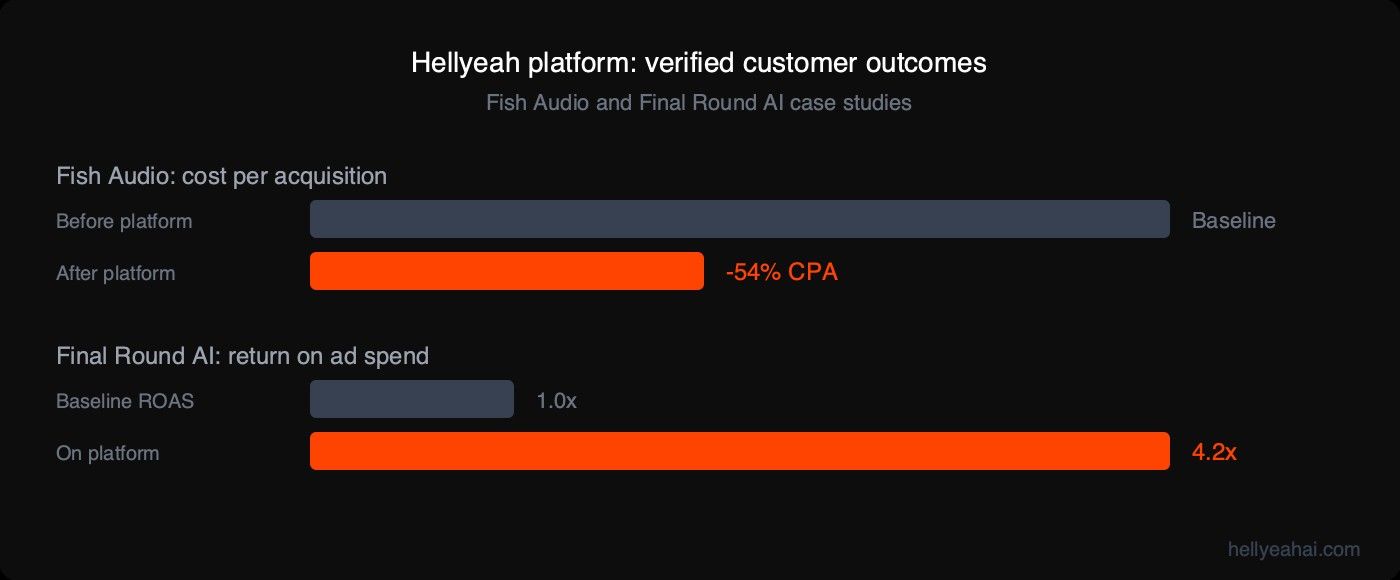
Fish Audio moved performance marketing execution to the Hellyeah platform and reduced cost per acquisition by 54% in the first 90 days. The result came from AIMA's ability to run significantly more creative variants per week than a manual production cycle allows, and then reallocate budget automatically to converting segments as signals appeared.
Final Round AI, running $12M in ARR, reached 4.2x return on ad spend on campaigns managed through the Hellyeah platform. The business did not add headcount to manage the campaign growth; AIMA handled the scaling.
Trade-offs
The constraint with AI platforms is the same as with any tool: garbage in, garbage out. A platform with a weak creative brief or a poorly defined conversion event will optimize toward the wrong goal. The execution is automated; the strategy still requires human judgment.
Timeline: Days to launch from onboarding Monthly cost: 5% of managed spend (Hellyeah), no media markup Channel coverage: Google Search, Performance Max, Meta (Hellyeah); varies by platform
Best for: Growth-stage companies running $10K to $500K or more per month in paid spend who need execution capacity without headcount cost, and teams that want cost transparency that agencies rarely provide. You can also explore Hellyeah's X-Ray for account analysis before committing to full managed execution.
See how AI advertising tools work across the full campaign lifecycle and the Madgicx review for paid media teams considering performance automation tools.
The three-way comparison argument tends to collapse once you run the cost math. Agencies charge a management fee plus a percentage of media, and most clients do not see the markup itemized until they get direct API access to their accounts. At $100K monthly spend, that gap is real and recurring. Kelly An, Hellyeah GTM and brand strategy lead
Side-by-Side Comparison
| Model | Cost at $100K spend | Time to launch | Creative speed | Cost transparency | Scalability |
|---|---|---|---|---|---|
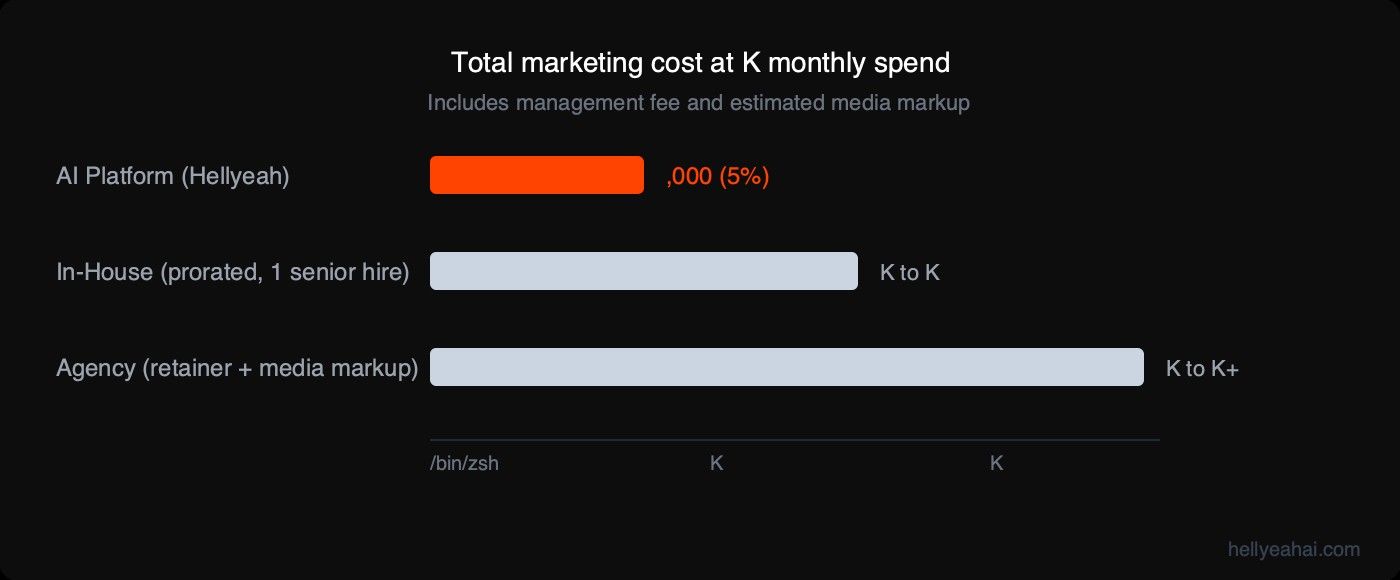
| AI Platform (Hellyeah) | 5% of spend ($5K) | Days | Automated, continuous | Full, no markup | Scales with spend |
| In-House | $8K-$12K (salary, prorated) | 60-90 days (hiring + ramp) | Team-size dependent | Full | Requires new hires |
| Agency | Retainer + media markup | 2-3 weeks | 1-2 week production cycles | Variable, markup common | Negotiated scope changes |
How to Decide Which Model Fits Your Team
| Your situation | Best model |
|---|---|
| $10K to $500K+ monthly spend, execution-bottlenecked, need cost transparency | AI platform (Hellyeah) |
| $500K+ monthly spend, Series B+, senior marketing lead already in place | In-house |
| New channel, no internal expertise, 6-month evaluation window | Agency |
| Strong in-house strategy and creative direction, need execution capacity | Hybrid: in-house strategy + AI platform execution |
Choose in-house if: Monthly ad spend is above $500K, you have a senior marketing leader already in place, and your campaigns require product knowledge that an external team would need 6 or more months to develop. At this scale and complexity, dedicated headcount pays for itself in performance quality and reaction speed.
Choose an agency if: You need to launch on a new channel immediately, you do not have internal expertise in that channel, and you have budget for a 6-month retainer to evaluate results. Be explicit in the contract about media cost structure and markup terms before signing. Ask whether media is passed through at cost and request documentation.
Choose an AI platform if: You are running $10K to $500K monthly in paid spend, your primary bottleneck is execution speed and creative iteration rather than strategic direction, and you want cost transparency without agency overhead. Book a demo with the Hellyeah team to see what AIMA would do differently with your current account.
Hybrid approaches work too: Some teams run in-house strategy and creative direction while using an AI platform for execution. Others maintain an agency relationship on a specific channel while using a platform for the rest. The key is assigning clear ownership: which model handles which decisions so accountability is not diffused when performance drops.
The most common failure mode is starting with an agency for speed, then staying with the agency past the point where the cost-to-value ratio makes sense, because switching feels disruptive. The switching cost is real but finite. A 6-week transition window with a properly documented brief is typically enough to move execution to an AI platform without meaningful performance degradation.
Related Guides
Frequently asked questions
Is in-house marketing cheaper than using an agency?
At high spend levels, in-house is often cheaper when you account for agency media markups. At early-growth spend levels below $100K per month, an agency or AI platform is typically more cost-efficient than carrying the fixed cost of a full-time hire with benefits and tool subscriptions.
What do performance marketing agencies charge?
Most charge a monthly retainer between $2,000 and $15,000 plus a percentage of managed media spend ranging from 10 to 20%. Some charge flat fees. Always ask specifically whether media is passed through at cost and request an itemized breakdown before signing.
Can an AI platform fully replace a performance marketing agency?
For execution tasks, yes: campaign structuring, bid management, creative testing, and optimization reporting. For strategic positioning, brand voice decisions, and channel strategy development, AI platforms still require human input. The strongest setup for most growth-stage teams is an AI platform for execution and a retained strategist, in-house or fractional, for direction.
How does Hellyeah's pricing compare to an agency?
Hellyeah charges 5% of managed ad spend with no media markup. At $100K in monthly spend, that is $5,000 a month with full cost transparency. A comparable agency retainer at the same spend level varies by firm and scope, but the combination of management fee plus media markup frequently pushes the effective total significantly above the management fee alone.
What is the biggest risk of switching from an agency to an AI platform?
The transition period. Most AI campaign engines need 4 to 6 weeks to accumulate enough conversion data to optimize effectively. Teams that switch expecting immediate results sometimes pull out before the model has run enough cycles to demonstrate its advantage. Budget a proper evaluation window, typically 8 weeks, before drawing conclusions about the platform's performance ceiling.
When does the hybrid model make sense?
When you have one channel that requires deep, relationship-based expertise, such as performance creative for complex B2B buyers, and other channels where execution volume and iteration speed matter more than relationship depth. Running an AI platform for Google and Meta while keeping a specialized agency or consultant for a niche channel is a workable structure for many mid-market teams.

Marketing
Marketing at Hellyeah. Writes about positioning, brand, and how automated systems earn trust.


